Frost & Sullivan
January 2013
Over the past two decades delivering goods into the cities has become a challenge with cities getting overly congested and traffic jams resulting in expensive logistics bottlenecks. In fact, studies show that the cost of congestion now in terms of time wasted in traffic and fuel consumption is off the roof, almost 200% more than what it was in the 1980s. And congestion is only a part of the urban delivery problem. Pollution, lack of parking bays, and warehousing costs are all restraints that are contributing to the economic cost of urban logistics.
There is already a paradigm shift in how products are being manufactured (3D printing) and retailed (transition to online channels) today and the common denominator, supply chain, at all stages of a product's lifecycle must quickly adapt to the changes as well. While it will take another decade or so for 3D printing to become mainstream, the growing market of online retail has already significantly impacted the industry. In order to understand these shifts, it is important to understand the megatrends that directly influence them.
Mega trends and Urban Logistics
We see four main Mega trends that will impact urban logistics - urbanisation, connectivity and convergence, bricks and clicks and multimodality (high speed rail).
Ir al reporte
Showing posts with label Freight Transport. Show all posts
Showing posts with label Freight Transport. Show all posts
Monday, February 4, 2013

Wednesday, April 25, 2012
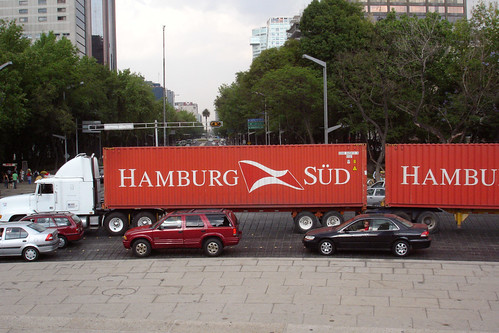
Challenges for urban freight in Mexico city
Freight Transport for Development
May 2011
 Foto: Omar Omar
This case study aims to show what freight transport related challenges policy makers in metropolitan areas are facing. It shows that interaction and cooperation within the institutional framework is very important and that a complex institutional framework jeopardizes good governance. The case study describes institutional challenges, environmental challenges and infrastructure related challenges. It also summarizes a number policy measures that could potentially improve the situation in Mexico city.
Bajar documento
May 2011
This case study aims to show what freight transport related challenges policy makers in metropolitan areas are facing. It shows that interaction and cooperation within the institutional framework is very important and that a complex institutional framework jeopardizes good governance. The case study describes institutional challenges, environmental challenges and infrastructure related challenges. It also summarizes a number policy measures that could potentially improve the situation in Mexico city.
Bajar documento
Sunday, April 22, 2012
Infraestructura y servicios de transporte ferroviario vinculados a las vías de navegación fluvial en América del Sur
Gordon Wilmsmeier
Serie de recursos naturales e infraestructura Nº 124
CEPAL
Octubre 2007
El transporte de carga ha abierto amplios horizontes para la economía internacional, permitiendo el avance de la especialización geográfica y que la industria utilice fuentes de servicio a escala global. Aún así, el mercado de transporte en América del Sur exige una integración adicional, incluyendo la conexión de todos los puntos nodales dentro de la región hasta las regiones fronterizas, casi siempre aisladas.
Dentro de las cargas transportadoras el transporte por ferrocarril en América del Sur sigue siendo el de menor importancia tanto a nivel nacional como subregional. Pero con el auge de la exportación y el interés renovado en el desarrollo de infraestructura crece la posibilidad de crear un nuevo enfoque, que incluye no solo la percepción unimodal, sino también la multimodal o intermodal.
Se destaca las posibilidades del transporte ferroviario de conectar regiones aisladas con las vías fluviales lo cual permite el fácil acceso a los puertos marítimos aguas abajo. En el presente estudio, se analiza este potencial bajo una visión conducente al desarrollo sustentable del transporte, con un impacto menor sobre el medio ambiente.
En base a un planteamiento metodológico y ejemplos, se llega a la conclusión de que es necesario iniciar un proceso político que tome en cuenta los impactos del transporte y la movilidad de las cargas. Este proceso debe poner énfasis en el potencial del desarrollo económico de regiones aisladas a través de la integración de los modos ferro-fluvial en América del Sur. Una visión unificada y la implementación de una política de transporte regional integrada puede resolver distorsiones y crear competitividad y eficiencia no solamente dentro del sector de transporte, sino también en su interacción con los otros sectores económicos y también sociales.
Bajar documento
Serie de recursos naturales e infraestructura Nº 124
CEPAL
Octubre 2007
El transporte de carga ha abierto amplios horizontes para la economía internacional, permitiendo el avance de la especialización geográfica y que la industria utilice fuentes de servicio a escala global. Aún así, el mercado de transporte en América del Sur exige una integración adicional, incluyendo la conexión de todos los puntos nodales dentro de la región hasta las regiones fronterizas, casi siempre aisladas.
Dentro de las cargas transportadoras el transporte por ferrocarril en América del Sur sigue siendo el de menor importancia tanto a nivel nacional como subregional. Pero con el auge de la exportación y el interés renovado en el desarrollo de infraestructura crece la posibilidad de crear un nuevo enfoque, que incluye no solo la percepción unimodal, sino también la multimodal o intermodal.
Se destaca las posibilidades del transporte ferroviario de conectar regiones aisladas con las vías fluviales lo cual permite el fácil acceso a los puertos marítimos aguas abajo. En el presente estudio, se analiza este potencial bajo una visión conducente al desarrollo sustentable del transporte, con un impacto menor sobre el medio ambiente.
En base a un planteamiento metodológico y ejemplos, se llega a la conclusión de que es necesario iniciar un proceso político que tome en cuenta los impactos del transporte y la movilidad de las cargas. Este proceso debe poner énfasis en el potencial del desarrollo económico de regiones aisladas a través de la integración de los modos ferro-fluvial en América del Sur. Una visión unificada y la implementación de una política de transporte regional integrada puede resolver distorsiones y crear competitividad y eficiencia no solamente dentro del sector de transporte, sino también en su interacción con los otros sectores económicos y también sociales.
Bajar documento
Seaports of the Americas Directory 2012
The authoritative and comprehensive guide to the seaports, port authorities and port industry of the Americas
American Association of Port Authorities
2012

AAPA's comprehensive annual profile & directory of the seaports, port authorities, terminal operators & port services industry of the Western Hemisphere and official annual AAPA membership directory. Published annually in March...in print and online.
Bajar documento
American Association of Port Authorities
2012
AAPA's comprehensive annual profile & directory of the seaports, port authorities, terminal operators & port services industry of the Western Hemisphere and official annual AAPA membership directory. Published annually in March...in print and online.
Bajar documento
Thursday, April 19, 2012
Urban Freight in Developing Cities
Bernhard O. Herzog
SUTP
November 2010
 This new GTZ Sourcebook module describes the importance of freight transportation in the context of urban development and provides detailed information on available options to meet current and future challenges for urban goods transport in rapidly growing cities of the developing world.
The module has been written by Bernhard O. Herzog, expert in the field of freight operation and fleet-management with more than 30 years experience in the field of transport planning and logistics.
The publication contains 62 fully illustrated pages 51 figures, 19 boxes and 8 tables. Additionally it provides further reading and links on additional aspects of urban freight.
Bajar documento
Bajar documento (in english)
SUTP
November 2010

The module has been written by Bernhard O. Herzog, expert in the field of freight operation and fleet-management with more than 30 years experience in the field of transport planning and logistics.
The publication contains 62 fully illustrated pages 51 figures, 19 boxes and 8 tables. Additionally it provides further reading and links on additional aspects of urban freight.
Bajar documento
Bajar documento (in english)
The impact of demand on cargo dwell time in ports in SSA
Beuran, Monica; Mahihenni, Mohamed Hadi; Raballand, Gael ; Refas, Salim;
World Bank
Policy Research working paper ; no. WPS 6014
Marzo 2012
Long cargo dwell times in ports are a critical issue in Sub-Saharan African countries since they result in slow import processes and are bound to dramatically reduce trade. The main objective of this study is to analyze long dwell times' causes in ports in Sub-Saharan Africa from a shipper's perspective. The findings point to the crucial importance of private sector practices and incentives. The authors argue in the case of Sub-Saharan African countries that private operators, rather than being advocates of reforms in this area, might be responsible for the failures of many of these initiatives. It seems that in Sub-Saharan Africa importers' and freight forwarders' professionalism, cash constraints and operators' strategies are some of the factors that have a major impact on cargo dwell time. Low competency, cash constraints and low storage tariffs explain why most importers have little incentive to reduce cargo dwell time since in most cases, this would increase their input costs. However, monopolists/cartels may have a stronger incentive to reduce cargo dwell time but only in order to maximize their profit (and would not adjust prices downward).
Bajar documento
World Bank
Policy Research working paper ; no. WPS 6014
Marzo 2012
Long cargo dwell times in ports are a critical issue in Sub-Saharan African countries since they result in slow import processes and are bound to dramatically reduce trade. The main objective of this study is to analyze long dwell times' causes in ports in Sub-Saharan Africa from a shipper's perspective. The findings point to the crucial importance of private sector practices and incentives. The authors argue in the case of Sub-Saharan African countries that private operators, rather than being advocates of reforms in this area, might be responsible for the failures of many of these initiatives. It seems that in Sub-Saharan Africa importers' and freight forwarders' professionalism, cash constraints and operators' strategies are some of the factors that have a major impact on cargo dwell time. Low competency, cash constraints and low storage tariffs explain why most importers have little incentive to reduce cargo dwell time since in most cases, this would increase their input costs. However, monopolists/cartels may have a stronger incentive to reduce cargo dwell time but only in order to maximize their profit (and would not adjust prices downward).
Bajar documento
Tuesday, April 17, 2012
Air Transport and Energy Efficiency
World Bank
Transport Paper Series - 38
Februrary 2012
 The air transport sector is enjoying an optimistic growth rate while at the same time eliciting growing concern, due to its environmental impact and its vulnerability with respect to energy security. This report aims to guide the air transport industry, policy makers, and development institutions on where to focus their investments or support in developing and emerging markets in order to address the energy and climate change challenges ahead.
Bajar documento
Transport Paper Series - 38
Februrary 2012

Bajar documento
Handbook of best practices at border crossings: A trade and transport facilitation perspective
OSCE - Organization for Security and Co-operation in Europe and UNECE
February 2012
 A practical guide for government agencies and private sector bodies which operate border crossing points. Published by the OSCE and the United Nations Economic Commission for Europe.
Table of contents:
Foreword
Overview
1. Trade and Customs: The International Legal Framework
2. From Domestic to International Co-operation
3. Balancing Security with Trade and Transport Facilitation and Developing Partnerships with Private Industry
4. Processing of Freight: Policies for Control, Clearance and Transit
5. Risk Management and Selectivity
6. Options for the Design of Border Crossing Points
7. Information and Communications Technology and Non-Intrusive Inspection
Photo: OSCE
8. Human Resource Management
9. Measuring Border Agency Performance: Possibilities for Benchmarking
ANNEX 1: Border definitions
ANNEX 2: International organizations
Photo Credits
Abbreviations and Acronyms
Bajar documento
Ver por capítulos
February 2012
Table of contents:
Foreword
Overview
1. Trade and Customs: The International Legal Framework
2. From Domestic to International Co-operation
3. Balancing Security with Trade and Transport Facilitation and Developing Partnerships with Private Industry
4. Processing of Freight: Policies for Control, Clearance and Transit
5. Risk Management and Selectivity
6. Options for the Design of Border Crossing Points
7. Information and Communications Technology and Non-Intrusive Inspection
Photo: OSCE
8. Human Resource Management
9. Measuring Border Agency Performance: Possibilities for Benchmarking
ANNEX 1: Border definitions
ANNEX 2: International organizations
Photo Credits
Abbreviations and Acronyms
Bajar documento
Ver por capítulos
UNCTAD Transport Newsletter
UNCTAD
Nº53 - First Quarter 2012
Content
Bajar documento
Nº53 - First Quarter 2012
Content
- Upcoming conference: Thirteenth session of the United Nations Conference on Trade and Development
- (UNCTAD XIII), 21‐26 April 2012, Doha, Qatar
- Ministerial Conference on Transport at ESCAP, Second Session, 12‐16 March 2012 Bangkok, Thailand: Asia‐
- Pacific nations reaffirm their commitment to efficient, reliable and safe transport infrastructure and
- services
- Newly published "Liability and Compensation for Ship‐Source Oil Pollution: An Overview of the International
- Legal Framework for Oil Pollution Damage from Tankers", UNCTAD Studies in Transport Law and Policy
- Newly published "Trade Facilitation in Regional Trade Agreements", from the UNCTAD Transport and Trade
- Facilitation Series
- UNCTAD project launched to develop Implementation Plans for an eventual WTO Trade Facilitation
- Agreement in several countries
- UNCTAD Case Study ‐ How to utilize FDI to improve transport infrastructure (Ports) ‐ Lessons from Nigeria
- The Low Carbon Shipping (LCS) Consortium
- Upcoming events under the UNCTAD Port Training Programme
- UNCTAD Technical Notes on Trade Facilitation now in Spanish
- Trade Facilitation as an Early Harvest under the WTO Doha Round
- Public Private Infrastructure Advisory Facility (PPIAF) Toolkit for PPPs
- OSCE‐UNECE Handbook of Best Practices at Border Crossings
- Data Harmonization and Modelling Guide for Single Window Environment
- Training Programmes on Trade Facilitation and Rules of Origin during 2012 and 2013
- Globalization and Transport
- Oil Spill Risk Management 2011
- Measuring and Managing CO2 Emissions of European Chemical Transport
- Time as a Trade Barrier
- TransFarm Africa Initiative ‐ Removing the Barriers to African agricultural production, Tanzania Case study
- All About Shipping
- Policy Analysis of Complex Transport Systems, 2‐7 June 2012, Azores, Portugal
- PortExecutive Seminar, 28‐29 June 2012, Marseilles, France
- Maritime Public Leaders’ Programme, 15‐23 October 2012, Singapore
- Intelligent Mobility – thinking about tomorrow’s transport
Bajar documento
Monday, April 16, 2012
Achieving emissions reductions in the freight sector: Understanding freight flows and exploring reduction options
Georgetown Climate Center
James J. Winebrake, PhD.
Rochester Institute of Technology
Presented via Webinar for the Talking Freight Seminar: Freight and the Environment Part I
21 March 2012
Freight is closely tied to economic growth and is growing; unfortunately, the bulk of freight is moved by high energy-intensive and GHG-intensive modes (truck).
On behalf of the Transportation and Climate Initiative, Dr. James Winebrake recently conducted an analysis of all freight moving through the northeastern United States.
The presentation shows some examples of emissions, costs and time for freight routes, and potentially sets the stage for additional work in this area.
The IF-TOLD Mitigation Framework
Bajar presentación
James J. Winebrake, PhD.
Rochester Institute of Technology
Presented via Webinar for the Talking Freight Seminar: Freight and the Environment Part I
21 March 2012
Freight is closely tied to economic growth and is growing; unfortunately, the bulk of freight is moved by high energy-intensive and GHG-intensive modes (truck).
On behalf of the Transportation and Climate Initiative, Dr. James Winebrake recently conducted an analysis of all freight moving through the northeastern United States.
The presentation shows some examples of emissions, costs and time for freight routes, and potentially sets the stage for additional work in this area.
The IF-TOLD Mitigation Framework
- Intermodalism/Infrastructure– use of efficient modes and infrastructure
- Fuels – use of low carbon fuels
- Technology – application of efficient technologies
- Operations – best practices in operator behavior
- Logistics – improve supply chain management
- Demand – reduce how much STUFF we consume
Bajar presentación
Sunday, April 15, 2012
Strategy 2030: Maritime trade and transport logistics
Hamburg Institute of International Economics
Berenberg Bank
2006
 Maritime Trade and Transport Logistics
HWWI (Part A)
Perspectives for maritime trade – Cargo shipping and port economics
Berenberg Bank (Part B)
Perspectives of maritime trade and transport logistics – Strategies for companies and investors
Global economic development in the past decades has been characterized by a rapidly progressing intensification in world trade and international division of labor. In recent decades, as a result of the expansive development of international merchandise trade, cargo shipping has been one of the fastest growing economic sectors. The progressive global integration processes, the future reduction in trade barriers, and the expected increase in prosperity in numerous regions of the world will also call for a marked expansion in world trade and cargo shipping. This designates maritime logistics as an economic sector with favorable perspectives for development. The present study – using as a starting point a forecast of the development of world trade up to the year 2030 – deals with development trends in cargo shipping and the related impact on ports in the European trade areas.
Bajar documento
Berenberg Bank
2006
HWWI (Part A)
Perspectives for maritime trade – Cargo shipping and port economics
Berenberg Bank (Part B)
Perspectives of maritime trade and transport logistics – Strategies for companies and investors
Global economic development in the past decades has been characterized by a rapidly progressing intensification in world trade and international division of labor. In recent decades, as a result of the expansive development of international merchandise trade, cargo shipping has been one of the fastest growing economic sectors. The progressive global integration processes, the future reduction in trade barriers, and the expected increase in prosperity in numerous regions of the world will also call for a marked expansion in world trade and cargo shipping. This designates maritime logistics as an economic sector with favorable perspectives for development. The present study – using as a starting point a forecast of the development of world trade up to the year 2030 – deals with development trends in cargo shipping and the related impact on ports in the European trade areas.
Bajar documento
Airport Economics in Latin America and the Caribbean: Benchmarking, regulation and pricing
World Bank
Directions in development - Infrastructure
Tomás Serebrisky
January 2012
 Traditionally, air transport infrastructure in Latin America and the Caribbean (LAC) was exclusively under government ownership and management. Starting in the late 1990s, several Latin American countries implemented innovative public-private partnerships (PPP) that transferred the financing and management of air transport sector infrastructure to the private sector. This book presents the findings of a first-ever, comprehensive study of how LAC region airports have evolved during this notable period of transition in airport ownership. It is an unbiased, positive analysis of what happened, rather than a normative analysis of what should be done to reform the airport sector or to attract private participation. It takes the first step in response to the need for more conclusive information about the influence of airport ownership on economic performance. The book is centered around the study of three dimensions of performance: productive efficiency, institutional set up for the governance of the sector, and financing of airport PPPs. Using rigorous analytical tools, this book answer a series of key questions to evaluate the introduction of private sector participation in the Latin American airport sector: Are LAC airports technically efficient? How has efficiency evolved in the last decade? Are privately-run airports more efficient than state-operated airports? How do independent regulators compare with government agencies in accountability, transparency, and autonomy? How has the level and structure of aeronautical tariffs changed in recent years? The main audience of this book are air transport practitioners, transport regulators, decisionmakers in transport ministries, and PPP units and academics.
Bajar documento
Directions in development - Infrastructure
Tomás Serebrisky
January 2012

Bajar documento
Plan de Movilidad de Montevideo
Intendencia de Montevideo
Febrero 2010

El objetivo general del Plan de Movilidad Urbana es la reestructuración y modernización del transporte urbano de Montevideo. El 30 de diciembre de 2008 la República Oriental del Uruguay firmó un convenio (Contrato de Préstamo Nº 2040/OC-UR) con el Banco Interamericano de Desarrollo para establecer una línea de crédito destinada a financiar el Plan por U$S 100.000.000.
El Organismo Ejecutor del Plan de Movilidad Urbana es la IMM, a través de la Unidad Ejecutiva del Plan de Movilidad Urbana, que depende del Departamento de Acondicionamiento Urbano.
El programa incluye entre los componentes a desarrollar:
Descargas
Libro "Plan de Movilidad, hacia un sistema de movilidad accesible, democrático y eficiente. 2010-2020"
Folleto "Plan de Movilidad, hacia un sistema de movilidad accesible, democrático y eficiente. 2010-2020"
Informe final Centro de Verificación Logística
Imágenes de Zona de actividad logística
Caracterizacion de camiones de acuerdo al MTOP
Resolución Departamental sobre limites al transporte de cargas
Resolución Departamental sobre limites al transporte de cargas
zonas_montevideo_referencias.jpg
Febrero 2010
El objetivo general del Plan de Movilidad Urbana es la reestructuración y modernización del transporte urbano de Montevideo. El 30 de diciembre de 2008 la República Oriental del Uruguay firmó un convenio (Contrato de Préstamo Nº 2040/OC-UR) con el Banco Interamericano de Desarrollo para establecer una línea de crédito destinada a financiar el Plan por U$S 100.000.000.
El Organismo Ejecutor del Plan de Movilidad Urbana es la IMM, a través de la Unidad Ejecutiva del Plan de Movilidad Urbana, que depende del Departamento de Acondicionamiento Urbano.
El programa incluye entre los componentes a desarrollar:
- Construcción y adecuación de carriles exclusivos y preferenciales, conservación y ampliación de la red vial, incluyendo obras de alumbrado público, readecuación de áreas verdes y calzadas.
- Obras en terminales de trasbordo e intercambiadores y reacondicionamiento urbano en sus zonas de influencia.
- Ampliación y sincronización de la red de semáforos.
- Señalización horizontal en pintura termoplástico.
- Señalización vertical en cartelería.
- Incorporación del sistema de información y billetaje electrónico en el transporte colectivo.
- Campañas de sensibilización y difusión.
- Consultas y encuestas a la población de Montevideo.
- Toda otra obra y acciones necesarias para llevar adelante el Plan de Movilidad Urbana.
Descargas
Libro "Plan de Movilidad, hacia un sistema de movilidad accesible, democrático y eficiente. 2010-2020"
Folleto "Plan de Movilidad, hacia un sistema de movilidad accesible, democrático y eficiente. 2010-2020"
Informe final Centro de Verificación Logística
Imágenes de Zona de actividad logística
Caracterizacion de camiones de acuerdo al MTOP
Resolución Departamental sobre limites al transporte de cargas
Resolución Departamental sobre limites al transporte de cargas
zonas_montevideo_referencias.jpg
Monday, March 26, 2012
Identifying and using low-cost and quickly implementable ways to address freight-system mobility constraints
TRB
2010

TRB’s National Cooperative Freight Research Program (NCFRP) Report 7: Identifying and Using Low-Cost and Quickly Implementable Ways to Address Freight-System Mobility Constraints explores standardized descriptions of the dimensions of the freight transportation system, identifies freight mobility constraints in a multimodal context, highlights criteria for low-cost and quickly implementable improvements to address the constraints, and includes a software tool to help decision makers in evaluating constraints and selecting appropriate improvements.
The software tool is available for download in a .zip format. A user guide for the software is also available for download.
Project: Project Information
E-Newsletter Type: Recently Released TRB Publications
TRB Publication Type: NCFRP Report
Bajar documento
Go to all the resources
2010
TRB’s National Cooperative Freight Research Program (NCFRP) Report 7: Identifying and Using Low-Cost and Quickly Implementable Ways to Address Freight-System Mobility Constraints explores standardized descriptions of the dimensions of the freight transportation system, identifies freight mobility constraints in a multimodal context, highlights criteria for low-cost and quickly implementable improvements to address the constraints, and includes a software tool to help decision makers in evaluating constraints and selecting appropriate improvements.
The software tool is available for download in a .zip format. A user guide for the software is also available for download.
Project: Project Information
E-Newsletter Type: Recently Released TRB Publications
TRB Publication Type: NCFRP Report
Bajar documento
Go to all the resources
Tuesday, January 24, 2012
Estudio de costos y sobrecostos de la cadena de servicios logísticos en los terminales portuarios de uso público
Autoridad Portuaria Nacional
Noviembre 2011

El objetivo principal de este estudio fue la determinación de los procesos y cuantificación de costos y sobrecostos a los que se enfrentan los dueños/consignatarios de la carga en la cadena logística de distribución física de mercancías, correspondiente al ámbito portuario, que permitan fortalecer las obligaciones de la APN y establecer políticas de desarrollo portuario para fortalecer la competitividad de los terminales portuarios de uso público y del comercio exterior peruano.
El estudio ha analizado los terminales portuarios del Callao, Paita, Salaverry, General San Martín, Ilo y Matarani.
Presentación del estudio
Parte I
Parte II
Parte III
Noviembre 2011
El objetivo principal de este estudio fue la determinación de los procesos y cuantificación de costos y sobrecostos a los que se enfrentan los dueños/consignatarios de la carga en la cadena logística de distribución física de mercancías, correspondiente al ámbito portuario, que permitan fortalecer las obligaciones de la APN y establecer políticas de desarrollo portuario para fortalecer la competitividad de los terminales portuarios de uso público y del comercio exterior peruano.
El estudio ha analizado los terminales portuarios del Callao, Paita, Salaverry, General San Martín, Ilo y Matarani.
Presentación del estudio
Parte I
Parte II
Parte III
Friday, January 20, 2012
Market-based instruments for international aviation and shipping as a source of climate finance
Michael Keen, Ian Parry and Jon Strand
World Bank
Policy Research Working Paper 5950
January 2012
The international aviation and maritime sectors today enjoy relatively favorable tax treatment, as their fuels are not taxed and the sectors are not subject to any value-added tax or turnover tax. Nor are these fuel uses subject to any global measures to reduce their associated CO2 emissions, even though they represent at least 5 percent of the global greenhouse gas emissions. A carbon charge on fuels for international aviation and shipping equal to $25 per tonne of emitted CO2 could raise about $12 billion from aviation and about $26 billion from shipping by 2020. Market-based instruments ought to be used to raise such revenue, preferably charges based on the carbon contents of fuels. Such charges would also scale back emissions by at least 5-10 percent. Developing countries ought to be able to keep their own tax revenue, and additional compensation to them for the economic burdens of these carbon charges may be warranted. Such compensation would constitute at most 40 percent of the raised global revenue. Implementing these charges can be a challenge, especially for aviation, where a large number of bilateral air-service agreements would need to be rewritten.
Bajar documento
World Bank
Policy Research Working Paper 5950
January 2012
The international aviation and maritime sectors today enjoy relatively favorable tax treatment, as their fuels are not taxed and the sectors are not subject to any value-added tax or turnover tax. Nor are these fuel uses subject to any global measures to reduce their associated CO2 emissions, even though they represent at least 5 percent of the global greenhouse gas emissions. A carbon charge on fuels for international aviation and shipping equal to $25 per tonne of emitted CO2 could raise about $12 billion from aviation and about $26 billion from shipping by 2020. Market-based instruments ought to be used to raise such revenue, preferably charges based on the carbon contents of fuels. Such charges would also scale back emissions by at least 5-10 percent. Developing countries ought to be able to keep their own tax revenue, and additional compensation to them for the economic burdens of these carbon charges may be warranted. Such compensation would constitute at most 40 percent of the raised global revenue. Implementing these charges can be a challenge, especially for aviation, where a large number of bilateral air-service agreements would need to be rewritten.
Bajar documento
Thursday, December 15, 2011
St Gotthard: The world's longest railway tunnel - Promoting the transfer of freight traffic from road to rail
Florence Pictet
PIARC
RR349-076
2011

Register before downloading documents
Download document
French version: St Gothard : le plus long tunnel ferroviaire du monde pour encourager le transfert du fret de la route au rail
PIARC
RR349-076
2011
Register before downloading documents
Download document
French version: St Gothard : le plus long tunnel ferroviaire du monde pour encourager le transfert du fret de la route au rail
Tuesday, December 13, 2011
Greenhouse gas issues in the North American trucking industry
Philippe Barla
From the issue entitled "Special Issue: Transport, energy and greenhouse gases: perspectives on demand limitation"
Guest Editors: Charles Raux & Martin E.H. Lee-Gosselin
Energy Efficiency, Volume 3, Number 2
In this paper, we examine some the issues associated with reducing greenhouse gas emissions in the North American trucking industry. We review some basic descriptive statistics to apprehend the basic conditions in the three countries of North America and describe the North American trucking industry and the changes in its GHG performance. We also present some of the policies that have been either implemented or are being considered to reduce trucking GHG emissions. We then discuss some of the issues involved in choosing instruments to reduce trucking emissions. Specifically, we discuss the following instruments: incentives and standard to improve truck fuel efficiency, a tax on CO2, and tradable permits systems.
Access the document
From the issue entitled "Special Issue: Transport, energy and greenhouse gases: perspectives on demand limitation"
Guest Editors: Charles Raux & Martin E.H. Lee-Gosselin
Energy Efficiency, Volume 3, Number 2
In this paper, we examine some the issues associated with reducing greenhouse gas emissions in the North American trucking industry. We review some basic descriptive statistics to apprehend the basic conditions in the three countries of North America and describe the North American trucking industry and the changes in its GHG performance. We also present some of the policies that have been either implemented or are being considered to reduce trucking GHG emissions. We then discuss some of the issues involved in choosing instruments to reduce trucking emissions. Specifically, we discuss the following instruments: incentives and standard to improve truck fuel efficiency, a tax on CO2, and tradable permits systems.
Access the document
Oil prices and maritime freight rates: An empirical investigation
UNCTAD
April 2010

Oil is the major energy source powering the global economy, supplying 95% of all the energy used in world transport.
Maritime transport, which carries over 80% of the volume of global merchandise trade, relies heavily on oil for propulsion, and in view of the limitations imposed by existing technology and costs, it is not yet in a position to adopt effective energy substitutes.
With oil becoming increasingly scarce and more costly to produce, and with prices having already risen to close to $150 per barrel (pb) in July 2008, the question of how changes in oil prices affect shipping costs is of considerable interest.
For the trade of many developing countries, excessive international transport costs already pose a considerable obstacle.
To help improve understanding of oil prices as a determinant of transport costs, UNCTAD conducted an empirical analysis of the relationship between oil prices and maritime freight rates. While the analysis focused on container transport, it also covered some dry and wet bulk trades, namely, iron ore and crude oil.
The findings of the analysis, presented in a technical report entitled Oil Prices and Maritime Freight Rates: An Empirical Investigation, confirm that rising oil prices drive up maritime freight rates in all three trades examined, with estimated elasticities varying, depending on the market segment and the specification.
For container trade, the effect of oil prices on container freight rates is estimated to be larger in periods of sharply rising and more volatile oil prices, compared to periods of low and stable oil prices.
These results entail some potentially important implications for maritime transport and trade, if oil prices resume the spiralling trend observed in 2007 and 2008 and sustain high and possibly unprecedented levels.
In view of the heavy reliance of maritime transport on oil for propulsion, further analytical work on the effect of energy prices on maritime freight rates is urgently required, especially as rising fuel costs may lead to proportionately higher maritime transport costs for developing countries.
In this context, energy security and investments in alternative, greener energy and technology for cost-efficient and sustainable maritime transportation conducive to trade and development are of the essence.
Download document
April 2010
Oil is the major energy source powering the global economy, supplying 95% of all the energy used in world transport.
Maritime transport, which carries over 80% of the volume of global merchandise trade, relies heavily on oil for propulsion, and in view of the limitations imposed by existing technology and costs, it is not yet in a position to adopt effective energy substitutes.
With oil becoming increasingly scarce and more costly to produce, and with prices having already risen to close to $150 per barrel (pb) in July 2008, the question of how changes in oil prices affect shipping costs is of considerable interest.
For the trade of many developing countries, excessive international transport costs already pose a considerable obstacle.
To help improve understanding of oil prices as a determinant of transport costs, UNCTAD conducted an empirical analysis of the relationship between oil prices and maritime freight rates. While the analysis focused on container transport, it also covered some dry and wet bulk trades, namely, iron ore and crude oil.
The findings of the analysis, presented in a technical report entitled Oil Prices and Maritime Freight Rates: An Empirical Investigation, confirm that rising oil prices drive up maritime freight rates in all three trades examined, with estimated elasticities varying, depending on the market segment and the specification.
For container trade, the effect of oil prices on container freight rates is estimated to be larger in periods of sharply rising and more volatile oil prices, compared to periods of low and stable oil prices.
These results entail some potentially important implications for maritime transport and trade, if oil prices resume the spiralling trend observed in 2007 and 2008 and sustain high and possibly unprecedented levels.
In view of the heavy reliance of maritime transport on oil for propulsion, further analytical work on the effect of energy prices on maritime freight rates is urgently required, especially as rising fuel costs may lead to proportionately higher maritime transport costs for developing countries.
In this context, energy security and investments in alternative, greener energy and technology for cost-efficient and sustainable maritime transportation conducive to trade and development are of the essence.
Download document
Greenhouse gas emissions from aviation and marine transportation: Migration potential and policies
David McCollum
Gregory Gould
David Greene
The Pew Center on Global Climate Change
December 2009

Combined, aviation and marine transportation are responsible for approximately 5 percent of total greenhouse (GHG) emissions in the United States and 3 percent globally and are among the fastest growing modes in the transportation sector. Controlling the growth in these emissions will be an important part of reducing emissions from the transportation sector. A range of near-, medium- and long-term mitigation options are available to slow the growth of energy consumption and GHG emissions from aviation and marine shipping. Implementation of these options could result in reductions of more than 50 percent below BAU levels by 2050 from global aviation and more than 60 percent for global marine shipping. For these reductions to be realized, however, international and domestic policy intervention is required. Developing an effective path forward that facilitates the adoption of meaningful policies remains both a challenge and an opportunity.
“Aviation and Marine Transportation: GHG Mitigation Potential and Challenges” presents an introduction to aviation and marine transportation and a discussion of the determinants of GHG emissions from transportation; gives overview of current emissions and trends and growth projections; explains the technological mitigation options and potential GHG emission reductions; and discusses policy options at both the domestic and international level to achieve deep and durable reductions in emissions.
Press Release
Download the report
Gregory Gould
David Greene
The Pew Center on Global Climate Change
December 2009
Combined, aviation and marine transportation are responsible for approximately 5 percent of total greenhouse (GHG) emissions in the United States and 3 percent globally and are among the fastest growing modes in the transportation sector. Controlling the growth in these emissions will be an important part of reducing emissions from the transportation sector. A range of near-, medium- and long-term mitigation options are available to slow the growth of energy consumption and GHG emissions from aviation and marine shipping. Implementation of these options could result in reductions of more than 50 percent below BAU levels by 2050 from global aviation and more than 60 percent for global marine shipping. For these reductions to be realized, however, international and domestic policy intervention is required. Developing an effective path forward that facilitates the adoption of meaningful policies remains both a challenge and an opportunity.
“Aviation and Marine Transportation: GHG Mitigation Potential and Challenges” presents an introduction to aviation and marine transportation and a discussion of the determinants of GHG emissions from transportation; gives overview of current emissions and trends and growth projections; explains the technological mitigation options and potential GHG emission reductions; and discusses policy options at both the domestic and international level to achieve deep and durable reductions in emissions.
Press Release
Download the report
Subscribe to:
Posts (Atom)