Jean SHAOUL, Anne STAFFORD and Pam STAPLETON
Manchester Business School,University of Manchester,
United Kingdom
September 2012
Discussion Paper No. 2012-6
Prepared for the Roundtable on: Public Private Partnerships for Funding Transport Infrastructure: Sources of Funding, Managing Risk and Optimism Bias
(27-28 September 2012)
International Transport Forum
A key message of this paper is that it is more costly for the public sector to use the private sector as financial intermediaries. This is due in part to the higher cost of commercial over public debt and the cost of the profit margin of both the private partner and its extensive supply chain. But there are also the not inconsiderable legal and financial advisors’ fees to each of the numerous parties to the transaction to structure and negotiate it
Bajar documento
Showing posts with label UK. Show all posts
Showing posts with label UK. Show all posts
Monday, January 28, 2013

Tuesday, April 17, 2012
Strategic Framework for Road Safety
Department for Transport
May 2011
 The Strategic Framework for Road Safety sets out our approach to continuing to reduce killed and seriously injured casualties on Britain’s roads. Our focus is on increasing the range of educational options for the drivers who make genuine mistakes and can be helped to improve while improving enforcement against the most dangerous and deliberate offenders. Additionally, at the local level, we will be increasing the road safety information that is available to local citizens.
Bajar documento
May 2011
Bajar documento
Wednesday, May 11, 2011
Improving the practice of transport project appraisal
Round Table 21-22 October 2010, Queretaro, Mexico.
Summary and Conclusions.
Discussion Paper No 2011-01
November 2010
International Transport Forum

Cost-benefit analysis (CBA) is indispensable for making good decisions on what transport projects to fund. It essentially aims to figure out which projects offer the best value for money. However, the practical relevance of CBA does not always live up to its appeal in principle. One problem is that there is sometimes disagreement over what to include in CBA, both on the cost side and the benefits side of the analysis. As a result, value for money is not always fully transparent. More politically, value for money is only a partial criterion for decision-making, leading to disagreement about the relative importance of the results from CBA compared to other inputs to the decision-making process.
This report examines the extent to which these shortcomings can be addressed. In terms of what to include in CBA, discussion focuses on equity and distributional impacts, productivity effects, agglomeration benefits and external costs. The focus then turns to how best to present guidance on project selection to decision makers. The report includes papers on the way CBA is used in three countries – France, Mexico and the United Kingdom – and how it is evolving in response to changing policy priorities.
Bajar documento
Summary and Conclusions.
Discussion Paper No 2011-01
November 2010
International Transport Forum
Cost-benefit analysis (CBA) is indispensable for making good decisions on what transport projects to fund. It essentially aims to figure out which projects offer the best value for money. However, the practical relevance of CBA does not always live up to its appeal in principle. One problem is that there is sometimes disagreement over what to include in CBA, both on the cost side and the benefits side of the analysis. As a result, value for money is not always fully transparent. More politically, value for money is only a partial criterion for decision-making, leading to disagreement about the relative importance of the results from CBA compared to other inputs to the decision-making process.
This report examines the extent to which these shortcomings can be addressed. In terms of what to include in CBA, discussion focuses on equity and distributional impacts, productivity effects, agglomeration benefits and external costs. The focus then turns to how best to present guidance on project selection to decision makers. The report includes papers on the way CBA is used in three countries – France, Mexico and the United Kingdom – and how it is evolving in response to changing policy priorities.
Bajar documento
Wednesday, January 12, 2011
The Future of Urban Transport
Department of transport
November 2009

Bajar el documento
November 2009
The Cabinet Office Strategy Unit, DfT and a number of other Government Departments have worked together in recent months to consider how transport can best support the success of our urban areas. The analysis, which is being published alongside this paper, has important implications for decision makers at all levels of government. This paper both provides a summary of the conclusions set out in more detail in the analysis and builds on it to offer a vision for the future of urban transport.
Firstly the paper highlights why our cities and large towns are so important and why effective transport systems are essential to making them successful. It considers how these transport systems affect different areas – economy, health and urban environment - both negatively and positively and proposes solutions which can produce positive outcomes to all of them: triple win outcomes.
The paper then puts forward a vision of urban transport that envisages enhanced mobility through a wider choice of journey, reduced congestion, better health and enjoyable urban spaces. The steps already taken towards this vision are recognised: for example the flexible legislative and policy framework available to local authorities.
Bajar el documento
Wednesday, January 5, 2011
International scan: Reducing Congestion and Funding Transportation Using Road Pricing
Federal Highway Administration International Programs
2010

Summary
Download the document
Access site
2010
Summary
The purpose of the International Scan was to identify new ideas and practical, workable models for integrating road pricing approaches into state, local, and regional policies, programs, and practices. The findings are intended to inform the U.S. road pricing research agenda and identify best practices from international experience that will assist U.S. practitioners.
The scan team visited with representatives from Sweden, the United Kingdom, Singapore, Germany, the Czech Republic, and the Netherlands in December 2009. The team was composed of representatives from the Federal Highway Administration (FHWA) and Federal Transit Administration (FTA); the Georgia, Minnesota, Virginia, and Washington State Departments of Transportation; the Port Authority of New Jersey and New York; and SRF Consulting Group, Inc. A list of scan team members is presented on the back cover.
Download the document
Access site
Thursday, October 28, 2010
Cost Damping in Travel Demand Models: Report of a study for the Department for Transport
Andrew Daly
RAND Technical Report

Contents
Chapter One:
International expertise
Chapter Two:
The relationship of cost sensitivity and trip length
Chapter Three:
The impact of microeconomic theory
Appendix:
The Kilometrage Test
Access the document
RAND Technical Report
Cost Damping is a feature in some travel demand models by which the marginal disutility of cost (and, possibly, of time) declines as journey lengths increase. It is present in many models in practical use in the UK and the Department for Transport sought recommendations for the advice it issues to local planners in the ‘WebTAG’ system: www.dft.gov.uk/webtag. The report makes a review of UK and limited international practice, a significant part of it due to RAND Europe, and discusses the advantages, disadvantages and theoretical backgrounds of the methods that are used, which can be reduced to eight principal model formulations, each in turn belonging to one of four essentially different types. Evidence of the importance of Cost Damping in practice is assessed. Tests of the model formulations are proposed, including a novel ‘kilometrage’ test, and a number of the model forms used in practice are found to be unsatisfactory with respect to one or other of these tests. The use of distance as a variable in the models is found to be unsatisfactory. The report goes on to show that microeconomic theory gives little insight into the appropriate forms of Cost Damping. Finally, a small number of Cost Damping mechanisms are recommended as being acceptable for use in practical modelling.
Contents
Chapter One:
International expertise
Chapter Two:
The relationship of cost sensitivity and trip length
Chapter Three:
The impact of microeconomic theory
Appendix:
The Kilometrage Test
Access the document
Friday, December 18, 2009
Integrating sustainability into Transport
Professor John Whitelegg
Stockholm Environment Institute
University of York
Presented in October 2007 - National Transport Conference - London
PDF
Stockholm Environment Institute
University of York
Presented in October 2007 - National Transport Conference - London
There are two ways of embarking on a discussion of sustainability in transport. One is primarily concerned with defining sustainability (usually through a discussion of climate change) and then detailing the seriously unsustainable trends we are currently experiencing and finishing with a flourish about how we could change trajectory and solve the problem through some serious policy changes. This route is well rehearsed in the transport policy literature and has had no impact whatsoever on changing trends. The other approach is to exploit the very large scenario literature, backcasting methodology and “visioning” tools that exist and paint a picture of what things could be like and how we would get there. In this paper I will explore this second approach and define sustainability and its links with transport through a vision of a future that is not very far away. This future will be presented as a picture of transport in the UK in 2030. This possible future, I will argue, has to be rooted in sustainability and this in turn requires a strongly practical integration of sustainability into the transport sector.
Friday, December 11, 2009
Highways Agency: contracting for highways maintenance
October 2009
"The latest form of Highways Agency contracts for maintaining motorways and trunk roads provide visibility of costs and the ability to allocate risk appropriately. But, as is so often the case, a lack of probing analysis of the information which is available, and continuing gaps in some areas undermine the drive to maximize value for money. The Agency has not yet established and benchmarked the unit costs of planned maintenance tasks, such as resurfacing; and it does not have enough of the information on or analysis of the continuing condition of assets necessary to drive down whole life costs of planned maintenance projects. The Highways Agency also now needs to strengthen the engineering and commercial management skills of its area teams."
Amyas Morse, head of the National Audit Office, 16 October 2009.Website
Full report
Also check:
- Department for Transport: Estimating and monitoring the costs of building roads in England
- Highways Agency: Maintaining England's Motorways and Trunk Roads
Monday, October 5, 2009
Mitigating Transport s Climate Change Impact in Scotland: Assessment of Policy Options
Scottish Government Social Research
August 2009
Acceder al documento
August 2009
In 2006, Scottish transport, including international aviation and shipping, accounted for 15.0 mega-tonnes of carbon dioxide equivalent (MtCO2e), or 24.4% of total Scottish greenhouse gas emissions. This figure, both in terms of absolute emissions and the proportion of total emissions, continues to grow on an annual basis.
Reducing emissions from transport is one of the National Transport Strategy’s three key strategic outcomes. On 5th December 2008 the Scottish Government published the Climate Change (Scotland) Bill, which includes a commitment to reduce emissions by 50% by 2030, and by 80% by 2050. The finalised version also includes
an interim target of 42% by 2020. These targets demonstrate a bold commitment by the Scottish Government. It signifies the importance Scotland places on playing its part in mitigating one of the most serious threats facing our world.
The Scottish Government’s Transport Directorate wants to improve its evidence base on how it can contribute to meeting emission reduction targets and appointed Atkins in partnership with the University of Aberdeen to undertake a study to identify, analyse, and report on the policy options available to the Scottish Government.
Statistical Bulletin: Transport Series
Scottish Government
August 2009
Has figures on (e.g.) road vehicles, traffic, accidents, toll bridges, bus and rail passengers, road and rail freight, air and water transport, personal travel and comparisons with Great Britain.
Acceder al documento
August 2009
Has figures on (e.g.) road vehicles, traffic, accidents, toll bridges, bus and rail passengers, road and rail freight, air and water transport, personal travel and comparisons with Great Britain.
Acceder al documento
Thursday, August 13, 2009

Monday, July 27, 2009
Department for Transport: Improving road safety for pedestrians and cyclists in Great Britain
National Audit Office
May 2009

In 2007, 2,946 people were killed on Great Britain’s roads. This is 18 per cent less than in the mid-1990s. Travelling by road is still one of the riskiest daily activities, however, and it accounts for nearly 97 per cent of transport deaths.
Pedestrians and cyclists are among the most vulnerable road users as they have little physical protection. People walk and cycle less than they used to. The Department for Transport can encourage more people to walk and cycle by making these activities safer.
The Department leads the promotion of road safety. But local highway authorities are responsible for most of the delivery work. Other organisations also contribute to improving road safety.
The report examines whether the Department:
Acceder al documento
May 2009
In 2007, 2,946 people were killed on Great Britain’s roads. This is 18 per cent less than in the mid-1990s. Travelling by road is still one of the riskiest daily activities, however, and it accounts for nearly 97 per cent of transport deaths.
Pedestrians and cyclists are among the most vulnerable road users as they have little physical protection. People walk and cycle less than they used to. The Department for Transport can encourage more people to walk and cycle by making these activities safer.
The Department leads the promotion of road safety. But local highway authorities are responsible for most of the delivery work. Other organisations also contribute to improving road safety.
The report examines whether the Department:
- is improving safety among pedestrians and cyclists,
- has an effective strategy and programme of activities for these groups, and
- works well with other organisations.
Acceder al documento
Tuesday, June 9, 2009
Public Transport Effects on Road Traffic: Potential and Limitations
Royal Automobile Club Foundation
Motoring Towards 2050 – Roads and Reality
Background Paper No.4
October 2008
The use of roads depends on transport modes used by people and those moving
goods. Clearly rail, water and airborne transport do not make direct demands on
the road network, but in many situations access to their terminals requires road
transport. The use of public transport depends on its price and service
characteristics in relation to current travel needs and these in turn depend on
modal characteristics network coverage and capacity. This note looks at the use
of public transport today, how it has changed over recent years and the role it is
likely to play in future.
The use of different means of transport depends on the types and patterns of
service required by people and those involved in logistics. These have changed
over the years with increasing reliance on road transport, with its greater ubiquity
and flexibility, and individualised forms of transportation that can quickly and
conveniently adapt as the demands made upon them change.
Acceder al documento
Motoring Towards 2050 – Roads and Reality
Background Paper No.4
October 2008
The use of roads depends on transport modes used by people and those moving
goods. Clearly rail, water and airborne transport do not make direct demands on
the road network, but in many situations access to their terminals requires road
transport. The use of public transport depends on its price and service
characteristics in relation to current travel needs and these in turn depend on
modal characteristics network coverage and capacity. This note looks at the use
of public transport today, how it has changed over recent years and the role it is
likely to play in future.
The use of different means of transport depends on the types and patterns of
service required by people and those involved in logistics. These have changed
over the years with increasing reliance on road transport, with its greater ubiquity
and flexibility, and individualised forms of transportation that can quickly and
conveniently adapt as the demands made upon them change.
Acceder al documento
Tuesday, May 5, 2009
Public-Private Partnerships for Highway Infrastructure: Capitalizing on International Experience
International Technology Scanning Program
Federal Highway Administration
March 2009
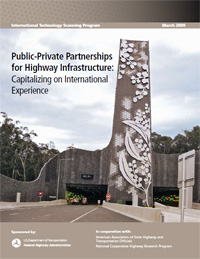
Public-private partnership (PPP) programs for highway infrastructure are not widely used in the United States. The Federal Highway Administration, American Association of State Highway and Transportation Officials, and National Cooperative Highway Research Program sponsored a scanning study to collect information about PPP programs for highway infrastructure in Australia, Portugal, Spain, and the United Kingdom, where PPP experience is more extensive. The scan team learned that PPPs are an effective strategy for delivering highway projects, and they are service arrangements as much as financial ones. The team observed that potential PPP projects must be analyzed and structured thoughtfully to preserve public interests and that managing the partnership over the life of the contract is critical to providing the services expected. Team recommendations for U.S. implementation include convening workshops, developing training guidelines, establishing an expert task group, developing a research strategy, and publishing principles and guideline documents on PPP topics.
Acceder al documento
Federal Highway Administration
March 2009
Public-private partnership (PPP) programs for highway infrastructure are not widely used in the United States. The Federal Highway Administration, American Association of State Highway and Transportation Officials, and National Cooperative Highway Research Program sponsored a scanning study to collect information about PPP programs for highway infrastructure in Australia, Portugal, Spain, and the United Kingdom, where PPP experience is more extensive. The scan team learned that PPPs are an effective strategy for delivering highway projects, and they are service arrangements as much as financial ones. The team observed that potential PPP projects must be analyzed and structured thoughtfully to preserve public interests and that managing the partnership over the life of the contract is critical to providing the services expected. Team recommendations for U.S. implementation include convening workshops, developing training guidelines, establishing an expert task group, developing a research strategy, and publishing principles and guideline documents on PPP topics.
Acceder al documento
Friday, March 20, 2009
Transport Trends: 2008 Edition
UK Department for Transport
February 2009
This publication presents an overview and analysis of trends in transport and travel in Great Britain over the past 25 years, and highlights some of the key issues. It is intended as a companion volume to Transport Statistics Great Britain, which contains reference tables of more detailed figures and some longer time trends.
Acceder al documento
February 2009
This publication presents an overview and analysis of trends in transport and travel in Great Britain over the past 25 years, and highlights some of the key issues. It is intended as a companion volume to Transport Statistics Great Britain, which contains reference tables of more detailed figures and some longer time trends.
Acceder al documento
Subscribe to:
Posts (Atom)