Vol 1: Synthesis report
U.S. Department of Transportation
Report to Congress
April 2010
A number of strategies can be used to reduce greenhouse gas emissions from transportation, such as using low-carbon fuels, increasing vehicle fuel economy, improving system efficiency and reducing travel that involves high levels of carbon emissions, according to a report released ... by the U.S. Department of Transportation (DOT).
Full Press release by Department of Transportation
Access the document
Showing posts with label Energy Efficiency. Show all posts
Showing posts with label Energy Efficiency. Show all posts
Tuesday, April 24, 2012

Thursday, April 19, 2012
Urban transport and energy efficiency
(Susanne Böhler-Baedeker and Hanna Hüging)
Module 5h - Sustainable Transport: A sourcebook for policy-makers in developing countries
SUTP
January 2012
 Considering the challenges of limited oil resources, increasing energy prices, climate change, environmental pollution and health risks, it is essential to establish an efficient transport system that meets demand, but consumes as little energy as possible. The SUTP Sourcebook Module 5h titled "Urban Transport and Energy Efficiency" serves as a navigator for decision makers and stakeholders, including local and national authorities, the private sector and non-governmental organisations. It provides a comprehensive overview of measures and policies designed to promote greater energy efficiency in transport, and assigns specific tasks and responsibilities to particular parties. Case studies illustrate international experiences in implementing measures to increase energy efficiency in transport.
Foto: Wuppertal Institute
Bajar documento (bottom of the page)
Module 5h - Sustainable Transport: A sourcebook for policy-makers in developing countries
SUTP
January 2012
Foto: Wuppertal Institute
Bajar documento (bottom of the page)
Tuesday, April 17, 2012
Air Transport and Energy Efficiency
World Bank
Transport Paper Series - 38
Februrary 2012
 The air transport sector is enjoying an optimistic growth rate while at the same time eliciting growing concern, due to its environmental impact and its vulnerability with respect to energy security. This report aims to guide the air transport industry, policy makers, and development institutions on where to focus their investments or support in developing and emerging markets in order to address the energy and climate change challenges ahead.
Bajar documento
Transport Paper Series - 38
Februrary 2012
Bajar documento
Monday, January 23, 2012
Laying the foundations for greener transport
TERM 2011: transport indicators tracking progress towards environmental targets in Europe
European Environment Agency
November 2011
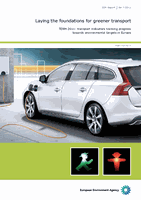
For the first time ever the European Commissions is proposing a greenhouse gas emissions target for transport. But how is transport going to provide the services that our society needs while minimising its environmental impacts? This is the theme for the Transport White Paper launched in 2011. TERM 2011 and future reports aim to deliver an annual assessment on progress towards these targets by introducing the Transport and Environment Reporting Mechanism Core Set of Indicators (TERM-CSI). TERM 2011 provides also the baseline to which progress will be checked against, covering most of the environmental areas, including energy consumption, emissions, noise and transport demand. In addition, this report shows latest data and discuss on the different aspects that can contribute the most to minimise transport impacts. TERM 2011 applies the avoid-shift-improve (ASI) approach, introduced in the previous TERM report, analysing ways to optimise transport demand, obtain a more sustainable modal split or use the best technology available.
Bajar documento
European Environment Agency
November 2011
For the first time ever the European Commissions is proposing a greenhouse gas emissions target for transport. But how is transport going to provide the services that our society needs while minimising its environmental impacts? This is the theme for the Transport White Paper launched in 2011. TERM 2011 and future reports aim to deliver an annual assessment on progress towards these targets by introducing the Transport and Environment Reporting Mechanism Core Set of Indicators (TERM-CSI). TERM 2011 provides also the baseline to which progress will be checked against, covering most of the environmental areas, including energy consumption, emissions, noise and transport demand. In addition, this report shows latest data and discuss on the different aspects that can contribute the most to minimise transport impacts. TERM 2011 applies the avoid-shift-improve (ASI) approach, introduced in the previous TERM report, analysing ways to optimise transport demand, obtain a more sustainable modal split or use the best technology available.
Bajar documento
Tuesday, December 13, 2011
Greenhouse gas issues in the North American trucking industry
Philippe Barla
From the issue entitled "Special Issue: Transport, energy and greenhouse gases: perspectives on demand limitation"
Guest Editors: Charles Raux & Martin E.H. Lee-Gosselin
Energy Efficiency, Volume 3, Number 2
In this paper, we examine some the issues associated with reducing greenhouse gas emissions in the North American trucking industry. We review some basic descriptive statistics to apprehend the basic conditions in the three countries of North America and describe the North American trucking industry and the changes in its GHG performance. We also present some of the policies that have been either implemented or are being considered to reduce trucking GHG emissions. We then discuss some of the issues involved in choosing instruments to reduce trucking emissions. Specifically, we discuss the following instruments: incentives and standard to improve truck fuel efficiency, a tax on CO2, and tradable permits systems.
Access the document
From the issue entitled "Special Issue: Transport, energy and greenhouse gases: perspectives on demand limitation"
Guest Editors: Charles Raux & Martin E.H. Lee-Gosselin
Energy Efficiency, Volume 3, Number 2
In this paper, we examine some the issues associated with reducing greenhouse gas emissions in the North American trucking industry. We review some basic descriptive statistics to apprehend the basic conditions in the three countries of North America and describe the North American trucking industry and the changes in its GHG performance. We also present some of the policies that have been either implemented or are being considered to reduce trucking GHG emissions. We then discuss some of the issues involved in choosing instruments to reduce trucking emissions. Specifically, we discuss the following instruments: incentives and standard to improve truck fuel efficiency, a tax on CO2, and tradable permits systems.
Access the document
Thursday, December 8, 2011
Understanding how ecodriving public education can result in reduced fuel use and greenhouse gas emissions
E. Martin, N. D. Chan, and S. A. Shaheen.
Innovative mobility
Submitted to TRB Annual Meeting 2012
November 2011

Ecodriving, the concept of changing driving behavior and vehicle maintenance to impact fuel consumption and greenhouse gas (GHG) emissions in existing vehicles, has gained recent prominence in North America. One ecodriving strategy involves public education through Internet-based information dissemination. This paper presents the results of a controlled stated-response study conducted with approximately 100 University of California, Berkeley faculty, staff, and students, assessing the effectiveness of static ecodriving web-based information. A comparison of the experimental and control groups found that exposure to ecodriving information influenced people's driving behavior and maintenance practices. The experimental group's distributional shift was statistically significant, particularly for key practices including: lower highway cruising speed, driving behavior adjustment, and proper tire inflation. Within the experimental group (N = 51), fewer respondents significantly changed their maintenance practices (16%) than the majority that altered some driving practices (71%); this suggests intentional altering of driving behavior is easier than planning better maintenance practices. A comparison of before- and after-surveys found that 57% of the experimental group improved their ecodriving behavior, while 43% made no change or worsened. Key characteristics of the drivers that improved include: being female, living in smaller households, and owning a newer car with higher fuel economy. While it was evident that not everyone modifies their behavior as a result of reviewing the website, even small shifts in behavior due to inexpensive information dissemination could be deemed cost effective in reducing fuel consumption and emissions.
Bajar documento
Innovative mobility
Submitted to TRB Annual Meeting 2012
November 2011
Ecodriving, the concept of changing driving behavior and vehicle maintenance to impact fuel consumption and greenhouse gas (GHG) emissions in existing vehicles, has gained recent prominence in North America. One ecodriving strategy involves public education through Internet-based information dissemination. This paper presents the results of a controlled stated-response study conducted with approximately 100 University of California, Berkeley faculty, staff, and students, assessing the effectiveness of static ecodriving web-based information. A comparison of the experimental and control groups found that exposure to ecodriving information influenced people's driving behavior and maintenance practices. The experimental group's distributional shift was statistically significant, particularly for key practices including: lower highway cruising speed, driving behavior adjustment, and proper tire inflation. Within the experimental group (N = 51), fewer respondents significantly changed their maintenance practices (16%) than the majority that altered some driving practices (71%); this suggests intentional altering of driving behavior is easier than planning better maintenance practices. A comparison of before- and after-surveys found that 57% of the experimental group improved their ecodriving behavior, while 43% made no change or worsened. Key characteristics of the drivers that improved include: being female, living in smaller households, and owning a newer car with higher fuel economy. While it was evident that not everyone modifies their behavior as a result of reviewing the website, even small shifts in behavior due to inexpensive information dissemination could be deemed cost effective in reducing fuel consumption and emissions.
Bajar documento
Tuesday, July 5, 2011
Repowering Transport 2011
World Economic Forum
April 2011

Global transportation and fossil fuels are inextricably linked. More than 60% of the 87 million barrels of oil consumed daily powers the world’s transportation system and liquid fossil fuels account for more than 96% of the sector’s energy supply.
The Repowering Transport project provides a high-level platform for executives from the World Economic Forum’s Industry Partners in the mobility (automotive, aviation, and logistics), energy (oil and gas, utilities, alternatives), chemicals, and investors industries, and select Global Growth Companies.The project explores technology-driven opportunities to drive short- to medium-term energy diversification and efficiency in the transportation sector. It provides a framework of key enablers – partnerships, policies, and financing mechanisms – that are critical to accelerate the development and deployment of these technologies.
Bajar documento
John Moavenzadeh, Senior Director and Head of Mobility Industries
April 2011
Global transportation and fossil fuels are inextricably linked. More than 60% of the 87 million barrels of oil consumed daily powers the world’s transportation system and liquid fossil fuels account for more than 96% of the sector’s energy supply.
The Repowering Transport project provides a high-level platform for executives from the World Economic Forum’s Industry Partners in the mobility (automotive, aviation, and logistics), energy (oil and gas, utilities, alternatives), chemicals, and investors industries, and select Global Growth Companies.The project explores technology-driven opportunities to drive short- to medium-term energy diversification and efficiency in the transportation sector. It provides a framework of key enablers – partnerships, policies, and financing mechanisms – that are critical to accelerate the development and deployment of these technologies.
Bajar documento
John Moavenzadeh, Senior Director and Head of Mobility Industries
Tuesday, June 21, 2011
Guía para la gestión del combustible en las flotas de transporte por carretera
Instituto para la Diversificación y Ahorro de la Energía - IDAE
Serie Eficiencia y Ahorro Energético - Eficiencia en el Transporte
Enero 2006

El IDAE ha decidido realizar la edición de la presente “Guía para la gestión del combustible en las flotas de transporte por carretera”, con el objeto de difundir a los profesionales de la gestión de flotas de transporte las nociones básicas y procedimientos utilizados para la realización de una gestión más eficiente del combustible. En la elaboración del manual, el IDAE ha contado con la colaboración de CEFTRAL (Confederación Española de Formación del Transporte y la Logística) y el apoyo del Ministerio del Interior (Dirección General de Tráfico) y del Ministerio de Fomento (Dirección General de Transportes por Carretera). Además, han participado también distintas flotas de transporte en el proceso de recopilación de información, mostrando sus sistemas y procedimientos de gestión del combustible.
Bajar documento
Serie Eficiencia y Ahorro Energético - Eficiencia en el Transporte
Enero 2006
El IDAE ha decidido realizar la edición de la presente “Guía para la gestión del combustible en las flotas de transporte por carretera”, con el objeto de difundir a los profesionales de la gestión de flotas de transporte las nociones básicas y procedimientos utilizados para la realización de una gestión más eficiente del combustible. En la elaboración del manual, el IDAE ha contado con la colaboración de CEFTRAL (Confederación Española de Formación del Transporte y la Logística) y el apoyo del Ministerio del Interior (Dirección General de Tráfico) y del Ministerio de Fomento (Dirección General de Transportes por Carretera). Además, han participado también distintas flotas de transporte en el proceso de recopilación de información, mostrando sus sistemas y procedimientos de gestión del combustible.
Bajar documento
Tuesday, May 24, 2011
Keeping climate change solutions on track: the role of rail
UIC
December 2010

Transport brings enormous benefits to society through access and mobility, but it also has many external costs, including its contribution to climate change. Transport has a key role to play within solutions to climate change as current transport structures are responsible for extreme pressures on energy resources and ecosystems through a dependence on fossil fuels.
Rail presents a low carbon mode of transport, and continued energy efficiency improvements and increases in modal shift to rail from road and air are crucial to support the transition to low carbon mobility.
The technological and operational developments in rail, financial investments from international funds and governments, and the commitment of rail operators demonstrate not only the current status of rail, but more importantly the potential for rail to contribute to global emissions reductions in 2010 and beyond. Indeed the rail sector is ready to be part of the solution to climate change; the UIC Declaration on Sustainable Mobility and Transport (attached at the end of this document) outlines this commitment.
Bajar documento
December 2010

Transport brings enormous benefits to society through access and mobility, but it also has many external costs, including its contribution to climate change. Transport has a key role to play within solutions to climate change as current transport structures are responsible for extreme pressures on energy resources and ecosystems through a dependence on fossil fuels.
Rail presents a low carbon mode of transport, and continued energy efficiency improvements and increases in modal shift to rail from road and air are crucial to support the transition to low carbon mobility.
The technological and operational developments in rail, financial investments from international funds and governments, and the commitment of rail operators demonstrate not only the current status of rail, but more importantly the potential for rail to contribute to global emissions reductions in 2010 and beyond. Indeed the rail sector is ready to be part of the solution to climate change; the UIC Declaration on Sustainable Mobility and Transport (attached at the end of this document) outlines this commitment.
Bajar documento
Wednesday, May 11, 2011
Uruguay - Eficiencia en infraestructura productiva y provisión de servicios: Sectores de transporte y electricidad
Informe de política de desarrollo (DPR)
VOLUMEN 2
Informe y Anexos
Banco Mundial
2008

1. El objetivo del DPR es revisar el estado de la infraestructura productiva del Uruguay y las políticas de desarrollo que la rigen, para proponer opciones de política de largo plazo que contribuyan a alcanzar un nivel de desarrollo económico mayor y sostenible, basado en la premisa que existe un vínculo entre el desarrollo de la infraestructura de un país y su crecimiento económico. El estudio presenta (i) un diagnóstico de los sectores de la infraestructura productiva que más impacto tienen en el la competitividad económica del país, usando como herramienta de análisis la medición de la eficiencia de los sectores, y el análisis de las instituciones y regulaciones y en qué medida éstas constituyen un obstáculo para que el Uruguay de un salto cualitativo importante en el desarrollo de su infraestructura y por consiguiente en su crecimiento económico y (ii) una agenda de opciones de políticas para los sectores de transportes y electricidad priorizada en términos del impacto en la competitividad de la economía. Este informe es, por consiguiente, un aporte importante al dialogo de política sectorial entre el país y el Banco Mundial.
El análisis se desarrolla en lo posible haciendo una distinción entre la infraestructura y su provisión y los servicios que en ella se apoyan y su provisión, de manera a dar una mayor profundidad al análisis y obtener mayor entendimiento sobre la interacción entre la provisión del servicio final y la infraestructura. Por ello, para que el análisis sea integral se estudió: (i) la infraestructura vial y el mercado del transporte de carga por carretera; (ii) el servicio de transporte ferroviario y su correspondiente infraestructura; (iii) el sistema portuario nacional y los servicios de transporte marítimos; y (iv) el servicio de suministro de electricidad en todos sus aspectos.
Bajar documento
VOLUMEN 2
Informe y Anexos
Banco Mundial
2008
Foto de la portada
1. El objetivo del DPR es revisar el estado de la infraestructura productiva del Uruguay y las políticas de desarrollo que la rigen, para proponer opciones de política de largo plazo que contribuyan a alcanzar un nivel de desarrollo económico mayor y sostenible, basado en la premisa que existe un vínculo entre el desarrollo de la infraestructura de un país y su crecimiento económico. El estudio presenta (i) un diagnóstico de los sectores de la infraestructura productiva que más impacto tienen en el la competitividad económica del país, usando como herramienta de análisis la medición de la eficiencia de los sectores, y el análisis de las instituciones y regulaciones y en qué medida éstas constituyen un obstáculo para que el Uruguay de un salto cualitativo importante en el desarrollo de su infraestructura y por consiguiente en su crecimiento económico y (ii) una agenda de opciones de políticas para los sectores de transportes y electricidad priorizada en términos del impacto en la competitividad de la economía. Este informe es, por consiguiente, un aporte importante al dialogo de política sectorial entre el país y el Banco Mundial.
El análisis se desarrolla en lo posible haciendo una distinción entre la infraestructura y su provisión y los servicios que en ella se apoyan y su provisión, de manera a dar una mayor profundidad al análisis y obtener mayor entendimiento sobre la interacción entre la provisión del servicio final y la infraestructura. Por ello, para que el análisis sea integral se estudió: (i) la infraestructura vial y el mercado del transporte de carga por carretera; (ii) el servicio de transporte ferroviario y su correspondiente infraestructura; (iii) el sistema portuario nacional y los servicios de transporte marítimos; y (iv) el servicio de suministro de electricidad en todos sus aspectos.
Bajar documento
Thursday, February 10, 2011
1º Inventário nacional de emissões atmosféricas por veículos automotores rodoviários: relatório final
Ministério do Meio Ambiente
Secretaria de Mudanças Climáticas e Qualidade Ambiental
Departamento de Mudanças Climáticas
Gerência de Qualidade do Ar
Janeiro 2011

Bajar documento
Press Release
Secretaria de Mudanças Climáticas e Qualidade Ambiental
Departamento de Mudanças Climáticas
Gerência de Qualidade do Ar
Janeiro 2011
O 1º Inventário Nacional de Emissões Atmosféricas por Veículos Automotores Rodoviários representa um subsídio valioso para a atuação do poder público e da própria sociedade no planejamento, implantação e acompanhamento de políticas voltadas à melhoria da qualidade ambiental e à mitigação das mudanças climáticas. Trata-se de um instrumento que, ao definir uma metodologia de referência nacional, restaura a missão institucional contínua de cumprir as demandas do principal marco normativo da gestão da qualidade do ar no país, o Programa Nacional de Controle da Qualidade do Ar (PRONAR), instituído pela Resolução CONAMA nº 5 de 1989 que pressupõe, entre outros, a implantação do Programa Nacional de Inventários de Fontes Poluidoras do Ar.
O presente documento apresenta as emissões de 1980 a 2009 e as projeções até 2020 dos poluentes regulamentados pelos programas PROCONVE e PROMOT: monóxido de carbono (CO), óxidos de nitrogênio (NOx), hidrocarbonetos não-metano (NMHC), aldeídos (RCHO) e material particulado (MP); além dos gases de efeito estufa, dióxido de carbono (CO2) e metano (CH4). O Inventário permite ainda, conhecer as contribuições relativas das frotas de automóveis, veículos comerciais leves, ônibus, caminhões e motocicletas nas emissões; e como as diferentes fases dos programas responsáveis desde 1986 pela introdução de combustíveis de melhor qualidade e tecnologias automotivas mais avançadas influenciaram, e ainda poderão influenciar as emissões.
Como instrumento de gestão ambiental, a elaboração do Inventário Nacional é, portanto, uma iniciativa que extrapola em muito a compilação de informações geradas por diferentes instituições públicas e privadas, permitindo que, entre seus inúmeros usos, contribua para a definição de novos limites de emissão, para a melhoria da qualidade dos combustíveis, ou sirva de subsídio a programas de eficiência energética. Quando detalhado para a escala local, constitui informação valiosa também para auxiliar na avaliação do impacto das emissões sobre a saúde humana e para o planejamento, a elaboração e a avaliação dos Planos de Controle de Poluição por Veículos em Uso (PCPV).
Press Release
Wednesday, October 27, 2010
Vision 2050: The new agenda for business
World Business Council for Sustainable Development
February 2010

Document details
English document
Documento en español: Una nueva agenda para los negocios
Mobilidad: P. 39
February 2010
The Vision 2050 report ( 2.6 MB) lays out a pathway leading to a global population of some 9 billion people living well, within the resource limits of the planet by 2050. This work results from an 18-month combined effort with CEOs and experts, and dialogues with over 200 companies and external stakeholders in some 20 countries.
The report spells out the “must haves” – the things that must happen over the coming decade to make a sustainable planetary society possible. These include incorporating the costs of externalities, starting with carbon, ecosystem services and water, into the structure of the marketplace; doubling agricultural output without increasing the amount of land or water used ; halting deforestation and increasing yields from planted forests: halving carbon emissions worldwide (based on 2005 levels) by 2050 through a shift to low-carbon energy systems and improved demand-side energy efficiency, and providing universal access to low-carbon mobility.
Vision 2050, with its best-case scenario for sustainability and pathways for reaching it, is a tool for thought leadership, a platform for beginning the dialogue that must take place to navigate the challenging years to come.
Document details
English document
Documento en español: Una nueva agenda para los negocios
Mobilidad: P. 39
Friday, December 11, 2009
Low-carbon development for Mexico
Todd M. Johnson, Claudio Alatorre, Zayra Romo and Feng Liu
World Bank
November 2009

Press Release
Acceder al documento 179 p.
World Bank
November 2009
This study presents new research on low-carbon interventions in the transport sector, including measures to improve the efficiency of both new and used vehicles as well as measures to improve urban transportation. Because a large percentage of transportation energy use occurs in Mexico's cities, there is significant potential for lowering greenhouse gas emissions by modifying the spatial organization of cities and improving the availability of public transportation infrastructure. Although major changes in urban design will take time to develop, other measures such as investing in bus rapid transit (BRT)-type systems, strengthening public transportation, and reorganizing freight transport systems can be implemented in the near term. This study analyzes a range of energy efficiency options available in Mexico, including supply-side efficiency improvements in the electric power and oil and gas industries, and demand-side electricity efficiency measures addressing high-growth energy-consuming activities, such as air conditioning and refrigeration. It also evaluates a range of renewable energy options that make use of the country's vast wind, solar, biomass, hydro, and geothermal resources. This study focuses on Mexico, many of the low-carbon options presented such as specific energy-efficiency and renewable energy technologies and urban transport or forestry programs are likely to be applicable to other countries.
Acceder al documento 179 p.
Thursday, December 10, 2009

Friday, October 2, 2009
World Development Report 2010: Development and Climate Change
World Bank
September 2009

Access the report
September 2009
Climate change is one of the most complex challenges of our young century. No country is immune. No country alone can take on the interconnected challenges posed by climate change, including controversial political decisions, daunting technological change, and farreaching global consequences.
As the planet warms, rainfall patterns shift and extreme events such as droughts, floods, and forest fires become more frequent. Millions in densely populated coastal areas and in island nations will lose their homes as the sea level rises. Poor people in Africa, Asia, and elsewhere face prospects of tragic crop failures; reduced agricultural productivity; and increased hunger, malnutrition, and disease.
As a multilateral institution whose mission is inclusive and sustainable development, the World Bank Group has a responsibility to try to explain some of those interconnections across disciplines—development economics, science, energy, ecology, technology, finance, and effective international regimes and governance. With 186 members, the World Bank Group faces the challenge, every day, of building cooperation among vastly different states, the private sector, and civil society to achieve common goods. This 32nd World Development Report seeks to apply that experience, combined with research, to advance knowledge about Development and Climate Change.
Access the report
Thursday, October 1, 2009
Lock-in Effects of Road Expansion on CO2 Emissions: Results from a Core-Periphery Model of Beijing
Policy Research Working Paper 5017
World Bank
August 2009
Acceder al documento
World Bank
August 2009
In the urban planning literature, it is frequently explicitly asserted or strongly implied that ongoing urban sprawl and decentralization can lead to development patterns that are unsustainable in the long run. One manifestation of such an outcome is that if extensive road investments occur, urban sprawl and decentralization are advanced and locked-in, making subsequent investments in public transit less effective in reducing vehicle kilometers traveled by car, gasoline use and carbon dioxide emissions. Using a simple core-periphery model of Beijing, the authors numerically assess this effect. The analysis confirms that improving the transit travel time in Beijing’s core would reduce the city’s overall carbon dioxide emissions, whereas the opposite would be the case if peripheral road capacity were expanded. This effect is robust to perturbations in the model’s calibrated parameters. In particular, the effect persists for a wide range of assumptions about how location choice depends on travel time and a wide range of assumptions about other aspects of consumer preferences.
Acceder al documento
Thursday, August 13, 2009
Electric bikes in the People s Republic of China: Impact on the environment and prospects for growth
Asian Development Bank
June 2009

Electric bikes (e-bikes) provide low-cost, convenient, and relatively energy-efficient transportation to an estimated 40 million�50 million people in the People's Republic of China (PRC), quickly becoming one of the dominant travel modes in the country. As e-bike use grows, concerns are rising about lead pollution from their batteries and emissions from their use of grid electricity, primarily generated by coal power plants. This report analyzes the environmental performance of e-bikes relative to other competing modes, their market potential, and the viability of alternative battery technologies. It also frames the role of e-bikes in the PRC's transportation system and recommends policy for decision makers in the PRC's central and municipal governments.
Acceder al documento
June 2009
Electric bikes (e-bikes) provide low-cost, convenient, and relatively energy-efficient transportation to an estimated 40 million�50 million people in the People's Republic of China (PRC), quickly becoming one of the dominant travel modes in the country. As e-bike use grows, concerns are rising about lead pollution from their batteries and emissions from their use of grid electricity, primarily generated by coal power plants. This report analyzes the environmental performance of e-bikes relative to other competing modes, their market potential, and the viability of alternative battery technologies. It also frames the role of e-bikes in the PRC's transportation system and recommends policy for decision makers in the PRC's central and municipal governments.
Acceder al documento
Monday, August 10, 2009
Low Carbon, High Growth: Latin American responses to Climate Change - An overview
Augusto de la Torre, Pablo Fajnzylber y John Nash
World Bank
“Low Carbon, High Growth: Latin American Responses to Climate Change”, is the World Bank's flagship report on Latin America and the Caribbean (LAC). It explores how the region is exposed to climate change impacts and what it can do to avert its effects, both unilaterally and with the incentives of a global climate agreement to be negotiated during 2009 in Copenhagen by the United Nations.
Acceder al documento
World Bank
“Low Carbon, High Growth: Latin American Responses to Climate Change”, is the World Bank's flagship report on Latin America and the Caribbean (LAC). It explores how the region is exposed to climate change impacts and what it can do to avert its effects, both unilaterally and with the incentives of a global climate agreement to be negotiated during 2009 in Copenhagen by the United Nations.
Acceder al documento
Increasing the energy efficiency of supply chains
McKinsey Quarterly
August 2009

The supply chains of many manufacturing sectors went global when oil was cheap; today, improving energy efficiency is a top concern for executives. This interactive shows numerous opportunities to dramatically reduce energy costs in supply chains.
Acceder al documento (Previo registro gratuito)
Especial interactivo
August 2009
The supply chains of many manufacturing sectors went global when oil was cheap; today, improving energy efficiency is a top concern for executives. This interactive shows numerous opportunities to dramatically reduce energy costs in supply chains.
Acceder al documento (Previo registro gratuito)
Especial interactivo
Friday, July 24, 2009
Biofuels in Asia: An Analysis of Sustainability Options
USAID Asia
2009
The US Agency for International Development's Regional Development Mission for Asia (USAID/RDMA) released a report called , Biofuels in Asia: An Analysis of Sustainability Options. The purpose of this report is to provide an objective and comprehensive regional analysis summarizing the benefits and risks of biofuels development in Asia, and examining the distribution and use of biofuels through the lens of global climate change; biodiversity conservation; energy alternatives; food security; economic development; and local livelihoods. This report does not undertake a detailed evaluation of biofuels in comparison to other clean energy supply options for power generation and transport.
Acceder al documento
2009
The US Agency for International Development's Regional Development Mission for Asia (USAID/RDMA) released a report called , Biofuels in Asia: An Analysis of Sustainability Options. The purpose of this report is to provide an objective and comprehensive regional analysis summarizing the benefits and risks of biofuels development in Asia, and examining the distribution and use of biofuels through the lens of global climate change; biodiversity conservation; energy alternatives; food security; economic development; and local livelihoods. This report does not undertake a detailed evaluation of biofuels in comparison to other clean energy supply options for power generation and transport.
Acceder al documento
Subscribe to:
Posts (Atom)