GAO
January 2012
Why GAO Did This Study
Many Americans spend frustrating hours each year stuck in traffic. While estimates vary, the Department of Transportation (DOT) estimates that traffic congestion costs the United States $200 billion each year, and that more than one-quarter of total annual travel time in metropolitan areas occurs in congested conditions. Road pricing or congestion pricing—assessing tolls that vary with the level of congestion or time of day—aims to motivate drivers to share rides, use transit, travel at less congested times, or pay to use tolled lanes. Since the first U.S. congestion pricing project opened in 1995, 19 project sponsors have 41 pricing projects in operation or under construction. About 400 miles of priced highway lanes including nearly 150 miles on the New Jersey Turnpike are in operation today with current tolls varying from 25 cents to $14.
All U.S. projects in operation are either High Occupancy Toll (HOT) lanes, which charge solo drivers to use newly constructed lanes or carpool lanes, or peak-period pricing projects, which charge a lower toll on already tolled roads, bridges and tunnels during offpeak periods. GAO examined (1) the federal role in supporting congestion pricing, (2) results of U.S. congestion pricing projects, and (3) emerging issues in congestion pricing. Eight project sponsors have current and completed evaluations on at least 1 project, for a total of 14 evaluated projects, all of which GAO reviewed. GAO interviewed officials about the performance of their pricing projects and effects. DOT provided technical comments, which GAO incorporated as appropriate.
Bajar documento
Highlights
Showing posts with label Congestion Pricing. Show all posts
Showing posts with label Congestion Pricing. Show all posts
Monday, January 23, 2012

Monday, August 15, 2011
Implementing Congestion Charges
OECD
April 2010

Recent advances in the scientific understanding of urban traffic congestion have only strengthened the already solid case for congestion charges as an element of a successful urban transport policy. But examples of real-world congestion charging systems remain few and far between. What can be done to improve the chances of their more widespread adoption in practice? This report draws lessons from attempts to introduce congestion charges.
Technology is not an obstacle, and technologies should serve policy purposes instead of define them. Charging systems are not cheap and thus should only be used where congestion is severe. Public acceptance is seen to be the key to successful implementation. Although environmental benefits and careful deployment of toll revenues may improve acceptance, a charging system should never lose sight of its principal aim, which is to reduce congestion.
Bajar documento
April 2010
Recent advances in the scientific understanding of urban traffic congestion have only strengthened the already solid case for congestion charges as an element of a successful urban transport policy. But examples of real-world congestion charging systems remain few and far between. What can be done to improve the chances of their more widespread adoption in practice? This report draws lessons from attempts to introduce congestion charges.
Technology is not an obstacle, and technologies should serve policy purposes instead of define them. Charging systems are not cheap and thus should only be used where congestion is severe. Public acceptance is seen to be the key to successful implementation. Although environmental benefits and careful deployment of toll revenues may improve acceptance, a charging system should never lose sight of its principal aim, which is to reduce congestion.
Bajar documento
Monday, August 8, 2011
The most of our money: Taxpayer friendly solutions for the nation's transportation challenges
Reason Foundation
Transportation for America
Taxpayers for common sense
May 2011

In the 20th Century, the United States built some of the world’s preeminent transportation systems, including a interstate highway network that’s second to none. The challenge for the 21st century is to maintain this infrastructure while expanding our ability to efficiently
move people and goods.
We face multiple challenges. Money is tight, as the gasoline tax we rely on to build and maintain our transportation network loses its earning power due to improved fuel efficiency and rising costs. Meanwhile, the nation’s transportation needs are increasing, as many of our roads, bridges, and railways fall deeper into a state of disrepair. All of this is occuring in the
context of trillion-dollar annual budget deficits and a $14 trillion national debt. There has never been a more critical time to do more with less.
This paper will introduce seven transportation tools – some big, some small – that can help improve our nation’s transportation system at taxpayer-friendly costs.
This paper offers some of the latest ideas and innovations that can inform the process as Congress writes the next six-year transportation bill. We hope members of Congress will be inspired to encourage, promote, and develop these and other cost-effective transportation measures.
Content:
Press release
Bajar documento
Transportation for America
Taxpayers for common sense
May 2011
Photo from the publication
In the 20th Century, the United States built some of the world’s preeminent transportation systems, including a interstate highway network that’s second to none. The challenge for the 21st century is to maintain this infrastructure while expanding our ability to efficiently
move people and goods.
We face multiple challenges. Money is tight, as the gasoline tax we rely on to build and maintain our transportation network loses its earning power due to improved fuel efficiency and rising costs. Meanwhile, the nation’s transportation needs are increasing, as many of our roads, bridges, and railways fall deeper into a state of disrepair. All of this is occuring in the
context of trillion-dollar annual budget deficits and a $14 trillion national debt. There has never been a more critical time to do more with less.
This paper will introduce seven transportation tools – some big, some small – that can help improve our nation’s transportation system at taxpayer-friendly costs.
This paper offers some of the latest ideas and innovations that can inform the process as Congress writes the next six-year transportation bill. We hope members of Congress will be inspired to encourage, promote, and develop these and other cost-effective transportation measures.
Content:
- Transportation Scenario Planning: Finding Ways to Get the Biggest Bang for the Buck
- High Occupancy Toll Lanes (HOT Lanes): Increasing Capacity with Roadway Pricing
- Bus Rapid Transit (BRT): A Cost-Effective Rapid Transit Option
- Intelligent Transportation Systems (ITS): Using Technology to Increase Capacity
- Intercity Buses: Connecting Communities with Taxpayer-Friendly Transportation
- Teleworking: Reducing Commuter Impacts on Congested Transportation Systems
- Local Street Connectivity: Protecting Investments in Major Corridors with Increased Local Connectivity
Press release
Bajar documento
Monday, August 1, 2011
Reducing congestion and funding transportation using road pricing in Europe and Singapore
Federal Highway Administration International Programs
December 2010
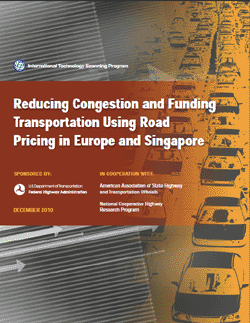
Congestion pricing use has been limited in the United States because of political, institutional, and public acceptance concerns. The Federal Highway Administration, American Association of State Highway and Transportation Officials, and National Cooperative Highway Research Program sponsored a scanning study of Europe and Singapore to identify ideas and models for integrating road pricing approaches into U.S. practices.
The scan team found that countries with clearly defined and well-understood policy goals were able to achieve targeted outcomes most effectively. The team also learned that a large-scale demonstration project is a good tool to build public acceptance of road pricing.
Team recommendations for U.S. implementation include enhanced outreach and communication on road pricing use and research on public perception issues and implementation barriers. The team also recommended development of a road pricing toolkit to provide transportation professionals with a comprehensive decision analysis tool to assess the merits of road pricing options.
Bajar documento
Executive summary
December 2010
Congestion pricing use has been limited in the United States because of political, institutional, and public acceptance concerns. The Federal Highway Administration, American Association of State Highway and Transportation Officials, and National Cooperative Highway Research Program sponsored a scanning study of Europe and Singapore to identify ideas and models for integrating road pricing approaches into U.S. practices.
The scan team found that countries with clearly defined and well-understood policy goals were able to achieve targeted outcomes most effectively. The team also learned that a large-scale demonstration project is a good tool to build public acceptance of road pricing.
Team recommendations for U.S. implementation include enhanced outreach and communication on road pricing use and research on public perception issues and implementation barriers. The team also recommended development of a road pricing toolkit to provide transportation professionals with a comprehensive decision analysis tool to assess the merits of road pricing options.
Bajar documento
Executive summary
Wednesday, May 11, 2011
Green growth and transport
Stephen Perkins
International Transport Forum
Discussion paper 2011 - 02
February 2011
Transport figures prominently on green growth agendas. The reason is twofold. First, transport has major environmental impacts in terms of greenhouse gas emissions, local air emissions and noise. And managing congestion more effectively is part of the broader agenda for more sustainable development and better use of resources invested in infrastructure. Second, a large part of public expenditure to stimulate green growth is directed at transport sector industries. This concerns most notably alternative vehicles, and particularly electric cars, a key part of strategies to decarbonise transport. Several countries also financed car scrapping and replacement schemes as a short term response to the 2008 financial crisis. The primary goal here was counter‐cyclical stimulus for the car manufacturing industry with, in most cases, a secondary goal of reducing CO2 emissions and fuel consumption through fleet renewal.
Some governments also include investment in high speed rail as a central element of longer term green growth policies, aiming at a shift in passenger traffic from cars and short haul aviation to rail. Green growth is a useful paradigm that re‐packages several existing concepts, including durable economic activity, reduced environmental impact and sustained growth in high quality jobs, under one banner and in such a way as to frame coherent, cross‐sectoral policies. But focusing on green growth as such does not obviate the need for governments to assess policies carefully according to their long‐term economic, environmental and social impacts. There are tradeoffs between the various dimensions of green growth. Reducing emissions, for example, comes at a cost to road users and to taxpayers and as green growth policies spread it may be necessary to review the way the transport sector is taxed and contributes to aggregate tax revenue (Van Dender and Crist 2010).
This section of the report briefly examines policies to support electric vehicles, vehicle replacement schemes and high speed rail and reviews the political economy of introducing congestion charges from experience to date with charging systems around the world. It ends with a review of indicators developed for the assessment of transport investments and policies. Assessment methodology is relatively mature in this sector and the tools developed to support transport sector decision‐making in some countries provide a good basis for the assessment of green growth apolicies cross the economy.
Bajar documento
Monday, May 9, 2011
The Review - America Latina
Steer Davies Gleave
Nº 1 Julio 2009

Bajar documento
Nº 1 Julio 2009
- San Juan "Waterfront"
- Construyendo ciudades amables
- El futuro del cobro por congestión
- Diagnósticos logísticos: su contribución a procesos eficientes
Bajar documento
Tarificación vial por congestión para la ciudad de Santiago
Preparado por Steer Davies Gleave
Estudios y Estadísticas
Ministerio de Tranportes y Telecomunicaciones de Chile
Setiembre 2009

El objetivo principal de este estudio es evaluar desde un punto de vista social la factibilidad técnica y económica de un Proyecto de Tarificación Vial por Congestión para la ciudad de Santiago. Dicho objetivo se enmarca dentro del propósito general de incentivar el uso racional del transporte privado y mitigar las externalidades negativas asociadas a su operación.
Resumen ejecutivo
Bajar documento final
Estudios y Estadísticas
Ministerio de Tranportes y Telecomunicaciones de Chile
Setiembre 2009
El objetivo principal de este estudio es evaluar desde un punto de vista social la factibilidad técnica y económica de un Proyecto de Tarificación Vial por Congestión para la ciudad de Santiago. Dicho objetivo se enmarca dentro del propósito general de incentivar el uso racional del transporte privado y mitigar las externalidades negativas asociadas a su operación.
Resumen ejecutivo
Bajar documento final
Friday, January 7, 2011
International Journal of Sustainable Transportation - Most cited articles 2007-2009
International Journal of Sustainable Transportation has a 2009 Impact Factor of .750!
Now you can read the most-cited articles from 2007-2009 for free:

D. A. Hensher, Some Insights into the Key Influences on Trip-Chaining Activity and Public Transport Use of Seniors and the Elderly
Volume 1, Issue 1, pp. 53-68.
B.P.Y. Loo, A.S.Y. Chow, Changing Urban Form in Hong Kong: What Are the Challenges on Sustainable Transportation?
Volume 2, Issue 3, pp. 177-193.
R. Cervero, O.L. Sarmiento, E. Jacoby, et al., Influences of Built Environments on Walking and Cycling: Lessons from Bogota
Volume 3, Issue 4, pp. 203-226.
M.G.H. Bell, Mixed Routing Strategies for Hazardous Materials: Decision-Making Under Complete Uncertainty
Volume 1, Issue 2, pp. 133-142.
E.T. Verhoef, H. Mohring, Self-Financing Roads Volume 3, Issue 5-6, pp.293-311.
J. Zacharias, The Nonmotorized Core of Tianjin Volume 1, Issue 4, pp. 231-248.
E. E. Boschmann, M. P. Kwan, Toward Socially Sustainable Urban Transportation: Progress and Potentials
Volume 2, Issue 3, pp. 138-157.
X.L. Guo, H. Yang, Analysis of a Build-Operate-Transfer Scheme for Road Franchising
Volume 3, Issue 5-6, pp. 312-338.
S. Brathen, J. Odeck, Road Funding in Norway: Experiences and Perspectives
Volume 3, Issue 5-6, pp. 373-388.
M. C. Coelho, T.L. Farias, N.M. Rouphail, A Numerical Tool for Estimating Pollutant Emissions and Vehicles Performance in Traffic Interruptions on Urban Corridors
Volume 3, Issue 4, pp. 246-262.
Bajar la lista de enlaces
Now you can read the most-cited articles from 2007-2009 for free:
D. A. Hensher, Some Insights into the Key Influences on Trip-Chaining Activity and Public Transport Use of Seniors and the Elderly
Volume 1, Issue 1, pp. 53-68.
B.P.Y. Loo, A.S.Y. Chow, Changing Urban Form in Hong Kong: What Are the Challenges on Sustainable Transportation?
Volume 2, Issue 3, pp. 177-193.
R. Cervero, O.L. Sarmiento, E. Jacoby, et al., Influences of Built Environments on Walking and Cycling: Lessons from Bogota
Volume 3, Issue 4, pp. 203-226.
M.G.H. Bell, Mixed Routing Strategies for Hazardous Materials: Decision-Making Under Complete Uncertainty
Volume 1, Issue 2, pp. 133-142.
E.T. Verhoef, H. Mohring, Self-Financing Roads Volume 3, Issue 5-6, pp.293-311.
J. Zacharias, The Nonmotorized Core of Tianjin Volume 1, Issue 4, pp. 231-248.
E. E. Boschmann, M. P. Kwan, Toward Socially Sustainable Urban Transportation: Progress and Potentials
Volume 2, Issue 3, pp. 138-157.
X.L. Guo, H. Yang, Analysis of a Build-Operate-Transfer Scheme for Road Franchising
Volume 3, Issue 5-6, pp. 312-338.
S. Brathen, J. Odeck, Road Funding in Norway: Experiences and Perspectives
Volume 3, Issue 5-6, pp. 373-388.
M. C. Coelho, T.L. Farias, N.M. Rouphail, A Numerical Tool for Estimating Pollutant Emissions and Vehicles Performance in Traffic Interruptions on Urban Corridors
Volume 3, Issue 4, pp. 246-262.
Bajar la lista de enlaces
Wednesday, January 5, 2011
International scan: Reducing Congestion and Funding Transportation Using Road Pricing
Federal Highway Administration International Programs
2010

Summary
Download the document
Access site
2010
Summary
The purpose of the International Scan was to identify new ideas and practical, workable models for integrating road pricing approaches into state, local, and regional policies, programs, and practices. The findings are intended to inform the U.S. road pricing research agenda and identify best practices from international experience that will assist U.S. practitioners.
The scan team visited with representatives from Sweden, the United Kingdom, Singapore, Germany, the Czech Republic, and the Netherlands in December 2009. The team was composed of representatives from the Federal Highway Administration (FHWA) and Federal Transit Administration (FTA); the Georgia, Minnesota, Virginia, and Washington State Departments of Transportation; the Port Authority of New Jersey and New York; and SRF Consulting Group, Inc. A list of scan team members is presented on the back cover.
Download the document
Access site
Friday, December 18, 2009
Nordic: Public Transport - Transportation for Everyone
Nordic: Road and Transport Research
No 3 2009
Contents:
What’s up? | p4
In Brief | p5
Smart Card Ticketing in Trondheim Delivers Substantial Benefits to Society | p6
Safe School Transportation in New EU project | p7
Technology Improves School Transport | p8
New Forms of Payment for the Provision of Public Transport | p10
Pedestrians in Danger | p11
The AKTA Project: Facilitates Everyday Life for Visually Impaired Persons | p12
Road Pavements and Fuel Consumption | p14
Child Pedestrians’ Quality Needs | p16
Østre Tangent – Connecting Bjørvika to the Inner City | p17
The ITS Scheme for Low Emission Zone in Norway | p18
Safety Effects of Intelligent In-vehicle Systems | p19
Road Pavement Ageing and Traffic Noise Levels | p20
Worn Windscreens – a Road Safety Problem | p21
Myths and Facts about Congestion Charging | p22
Self-explaining Roads | p23
Access the document
Saturday, December 12, 2009
An analysis of various policy instruments to reduce congestion, fuel consumption and CO2 emissions in Beijing
Anas, Alex; Timilsina, Govinda R.; Zheng, Siqi
Policy Research working paper ; No.5068
World Bank
October 2009
Access the website
Access the pdf
Policy Research working paper ; No.5068
World Bank
October 2009
Using a nested multinomial logit model of car ownership and personal travel in Beijing circa 2005, this paper compares the effectiveness of different policy instruments to reduce traffic congestion and CO2 emissions. The study shows that a congestion toll is more efficient than a fuel tax in reducing traffic congestion, whereas a fuel tax is more effective as a policy instrument for reducing gasoline consumption and emissions. An improvement in car efficiency would also reduce congestion, fuel consumption, and CO2 emissions significantly; however, this policy benefits only richer households that own a car. Low-income households do better under the fuel tax policy than under the efficiency improvement and congestion toll policies. The congestion toll and fuel tax require the travel cost per mile to more than triple. The responsiveness of aggregate fuel and CO2 are, approximately, a 1 percent drop for each 10 percent rise in the money cost of a car trip.
Access the website
Access the pdf
Friday, December 11, 2009
Fuel Tax Incidence in Developing Countries The Case of Costa Rica
Allen Blackman, Rebecca Osakwe, and Francisco Alpizar
Environment for Development
Discussion Paper Series EfD DP 09-24
Resources for the future
October 2009
website
Access the paper
Environment for Development
Discussion Paper Series EfD DP 09-24
Resources for the future
October 2009
Although fuel taxes are a practical means of curbing vehicular air pollution, congestion, and accidents in developing countries—all of which are typically major problems—they are often opposed on distributional grounds. Yet few studies have investigated fuel tax incidence in a developing country context. We use household survey data and income-outcome coefficients to analyze fuel tax incidence in Costa Rica. We find that the effect of a 10 percent fuel price hike through direct spending on gasoline would be progressive, its effect through spending on diesel—both directly and via bus transportation would be regressive (mainly because poorer households rely heavily on buses), and its effect through spending on goods other than fuel and bus transportation would be relatively small, albeit regressive.
Finally, we find that although the overall effect of a 10 percent fuel price hike through all types of direct and indirect spending would be slightly regressive, the magnitude of this combined effect would be modest. We conclude that distributional concerns need not rule out using fuel taxes to address pressing public health and safety problems, particularly if gasoline and diesel taxes can be differentiated.
Access the paper
Impacts of policy instruments to reduce congestion and emissions from urban transportation: the case of Sao Paulo, Brazil
Anas, Alex; Timilsina, Govinda R.
Policy Research Working Paper Nº 5099
World Bank
October 2009
website
Access the paper
Policy Research Working Paper Nº 5099
World Bank
October 2009
This study examines impacts on net social benefits or economic welfare of alternative policy instruments for reducing traffic congestion and atmospheric emissions in São Paulo, Brazil. The study shows that expanding road networks, subsidizing public transit, and improving automobile fuel economy may not be as effective as suggested by economic theories because these policies could cause significant rebound effects. Although pricing instruments such as congestion tolls and fuel taxes would certainly reduce congestion and emissions, the optimal level of these instruments would steeply increase the monetary cost of travel per trip and are therefore politically difficult to implement. However, a noticeable finding is that even smaller tolls, which are more likely to be politically acceptable, have substantial benefits in terms of reducing congestion and emissions. Among the various policy instruments examined in the study, the most socially preferable policy option for São Paulo would be to introduce a mix of congestion toll and fuel taxes on automobiles and use the revenues to improve public transit systems.
website
Access the paper
Monday, June 8, 2009
Keeping the wheels from falling off: Why England needs a new urban transport investment fund
Adam Marshall
Centre for cities
April 2009

With each passing week, the public finances look more and more precarious. For England’s cities, the next decade is likely to be marked by a wide-ranging cutback in Government capital investment, with transport and other infrastructure projects pared back significantly. Despite transport’s role as an enabler of economic growth, it remains low on Ministers’ priority lists – well behind education, health and defence.
Yet public transport infrastructure needs – especially in England’s regional cities – remain significant. A decade of increased spending has not closed the ‘infrastructure gap’faced by cities like Leeds, Manchester, Birmingham, Cambridge, Reading or Bristol. So if cities are to lead the economic recovery over the longer term, new sources of transport investment will be urgently required.
This Policy Solutions note sets out a blueprint for a new Urban Transport Investment Fund. The Fund is not a new Government spending programme – but a way to simultaneously deliver high-quality public transport infrastructure and returns for central government, local authorities and private sector investors. Over the next year, we urge all major political parties to work with cities to build up detailed plans to launch a city-focused transport Fund, following the 2010 General Election.
Acceder al documento
Centre for cities
April 2009
With each passing week, the public finances look more and more precarious. For England’s cities, the next decade is likely to be marked by a wide-ranging cutback in Government capital investment, with transport and other infrastructure projects pared back significantly. Despite transport’s role as an enabler of economic growth, it remains low on Ministers’ priority lists – well behind education, health and defence.
Yet public transport infrastructure needs – especially in England’s regional cities – remain significant. A decade of increased spending has not closed the ‘infrastructure gap’faced by cities like Leeds, Manchester, Birmingham, Cambridge, Reading or Bristol. So if cities are to lead the economic recovery over the longer term, new sources of transport investment will be urgently required.
This Policy Solutions note sets out a blueprint for a new Urban Transport Investment Fund. The Fund is not a new Government spending programme – but a way to simultaneously deliver high-quality public transport infrastructure and returns for central government, local authorities and private sector investors. Over the next year, we urge all major political parties to work with cities to build up detailed plans to launch a city-focused transport Fund, following the 2010 General Election.
Acceder al documento
Tuesday, June 2, 2009
Pricing Urban Congestion
Ian W.H. Parry
Resources for the Future Institute
Discussion Paper
November 2008
This paper reviews literature on the optimal design of pricing policies to reduce urban automobile congestion. The implications of a range of complicating factors are considered, such as traffic bottlenecks, constraints on which roads and freeway lanes in the road network can be priced, driver heterogeneity, private toll operators, other externalities besides congestion, and interactions between congestion taxes and the broader fiscal system. We also briefly discuss the incidence of congestion taxes
and experience with this policy in the United States and elsewhere.
Although the economics literature on congestion pricing has advanced considerably over the last 20 years, research is still needed on the empirical measurement of second-best efficient tolls for urban centers and whether alternative design features have substantial implications for efficiency. More research is also needed on the design of schemes to promote feasibility by compensating adversely affected groups
with minimal loss in economic efficiency.
Acceder al documento
Equity and Congestion Pricing: A Review of the Evidence
Liisa Ecola and Thomas Light
RAND
May 2009

Transportation policymakers are increasingly considering congestion pricing a promising option for addressing urban traffic-congestion problems. While some congestion pricing projects have been undertaken in the United States, many proposals have been rejected based on worries that congestion pricing is inequitable. This report looks at the evidence that might support or negate this claim. As congestion pricing has been both studied and implemented more widely, a body of evidence based on both real-world implementations and models of proposed and hypothetical congestion pricing systems has been growing. While a number of papers have been published in this area, it has been difficult to reach general conclusions about whether congestion pricing is equitable. This report provides an overview of the literature from both economists and transportation planners to highlight what is known about the equity implications of congestion pricing.
Acceder al documento
RAND
May 2009
Transportation policymakers are increasingly considering congestion pricing a promising option for addressing urban traffic-congestion problems. While some congestion pricing projects have been undertaken in the United States, many proposals have been rejected based on worries that congestion pricing is inequitable. This report looks at the evidence that might support or negate this claim. As congestion pricing has been both studied and implemented more widely, a body of evidence based on both real-world implementations and models of proposed and hypothetical congestion pricing systems has been growing. While a number of papers have been published in this area, it has been difficult to reach general conclusions about whether congestion pricing is equitable. This report provides an overview of the literature from both economists and transportation planners to highlight what is known about the equity implications of congestion pricing.
Acceder al documento
Friday, May 15, 2009
Income-Based Equity Impacts of Congestion Pricing: A Primer
U.S. Federal Highway Administration
May 2009

The U.S. Federal Highway Administration has released a report that explores the impacts of congestion pricing on low-income groups, public opinion as expressed by various income groups, and ways to mitigate the equity impacts of congestion pricing.
Acceder al documento
May 2009
The U.S. Federal Highway Administration has released a report that explores the impacts of congestion pricing on low-income groups, public opinion as expressed by various income groups, and ways to mitigate the equity impacts of congestion pricing.
Acceder al documento
Technologies That Enable Congestion Pricing: A Primer
U.S. Federal Highway Administration
May 2009

The U.S. Federal Highway Administration has released a report that examines the use of primary and advanced technology to support tolling and congestion pricing.
Acceder al documento
May 2009
The U.S. Federal Highway Administration has released a report that examines the use of primary and advanced technology to support tolling and congestion pricing.
Acceder al documento
Tuesday, May 12, 2009
Pricing as a tool for funding and regulation in an equity s perspective
PIARC
April 2009
Traditionally, instruments such as taxes, charges and tolls have been used for funding infrastructure construction and maintenance. In recent years, pricing has been used for regulatory purposes as a measure against congestion, for mitigating environmental impacts; and for safety improvement.
The question whether road pricing could be a useful instrument and in which way it should be applied can only be sufficiently answered after clearly defining the objectives of the instrument. Does the priority lie in improving the environmental situation, in creating more financial sources for infrastructure projects in the transport sector or is the main purpose to reach a better usage of existing infrastructure capacities and/or a general reduction in road traffic? Possible tools for different objectives are discussed in the report.
Pricing is usually introduced in a given economic, geographical and social context, and following more or less well defined objectives. Experiences are mostly successful but raise concerns about equity. There is need for precise definition of Road Pricing if one wants to consider equity issues. Different designs of Road Pricing have to be distinguished and the allocation of the revenue has to be considered. The intended use of revenue from pricing will strongly influence not only the effective ex-post distribution but also the ex-ante perception of equity of specific projects.
In addition, specific application of Road Pricing - e.g. as a fee for using a tunnel, as a charge for entering a city area or for driving on a special motorway lane - has to be discussed in the context of the overall transport policy and especially other fiscal measures like gasoline charges and vehicle taxes.
The introduction of a specific pricing scheme influences vertical (by income group), horizontal (by interest group) and geographical (by area) distribution of costs and benefits. The expected distribution impacts will largely determine the acceptance of a given project.
Considering overall costs and benefits, pricing impacts in general can be evaluated based on consumer surplus analysis with the help of a socio-economic model. These models assist in estimating the value that consumers place on goods and services they use.
In reality, acceptability does not only depend on distribution among groups (horizontal distribution) but also on vertical and geographical distribution of costs and benefits. Although a quantitative assessment was not done, the working group presents some considerations on these issues based on existing literature and intuition.
Acceder al documento
Monday, April 27, 2009
The Transportation Issue
Good Magazine
April 2009
Reinventing Our Wheels: Visionary ideas for the coming transportation revolution.

Content:
-How To Double Your Car’s Fuel Economy Without Spending Any Money
-The Electric Car Rides Again
-Sharing is Car-ing
-I Dream of Light-rail: Baltimore: Red Line
-Walk On: A look at America’s most pedestrian friendly cities
-Get On the Bus: For proof that buses can solve most of our mass-transit problems, look no further than Bogotá.
-Convenience Is King: You can take the train to work, but your office is still a mile away from the station. Might as well drive, right? How we can solve the last-mile problem.
-Prettier Buses Get More Rides
-Ticket to Ride: How to appease the interest groups keeping congestion pricing from our cities.
-Transportation Innovation
-Infra What?: A brief look at where that $100 billion worth of infrastructure money is going
-Who’s Driving?: These people will shape transportation policy during the next four years.
-Going Down The Rabbit Hole: The future of transportation may mean not moving at all.
-The End of the Roads: We have as much road capacity today as we will ever need.
-Sorry, Portland: A primer on the best burgeoning bike scenes in North America
Acceder al documento
April 2009
Reinventing Our Wheels: Visionary ideas for the coming transportation revolution.
Content:
-How To Double Your Car’s Fuel Economy Without Spending Any Money
-The Electric Car Rides Again
-Sharing is Car-ing
-I Dream of Light-rail: Baltimore: Red Line
-Walk On: A look at America’s most pedestrian friendly cities
-Get On the Bus: For proof that buses can solve most of our mass-transit problems, look no further than Bogotá.
-Convenience Is King: You can take the train to work, but your office is still a mile away from the station. Might as well drive, right? How we can solve the last-mile problem.
-Prettier Buses Get More Rides
-Ticket to Ride: How to appease the interest groups keeping congestion pricing from our cities.
-Transportation Innovation
-Infra What?: A brief look at where that $100 billion worth of infrastructure money is going
-Who’s Driving?: These people will shape transportation policy during the next four years.
-Going Down The Rabbit Hole: The future of transportation may mean not moving at all.
-The End of the Roads: We have as much road capacity today as we will ever need.
-Sorry, Portland: A primer on the best burgeoning bike scenes in North America
Acceder al documento
Subscribe to:
Posts (Atom)